Founders frequently ask for a quick ballpark quote for "a mobile app"—only to be surprised when credible engineering estimates start several times higher than a corporate website. That gap exists because a production mobile product is rarely one piece of software. It is usually three connected systems shipped together: an iOS client, an Android client, and a secure cloud backend with an administrative web console.
If you are planning mobile app development cost in Nigeria in 2026, here is a transparent breakdown of real market brackets, platform trade-offs, hidden compliance requirements, and practical ways to protect your capital during version one.
Why Mobile Apps Cost More Than Standard Websites
Even a seemingly simple mobile application demands engineering workflows that websites do not:
- App Store Review & Compliance: Both the Apple App Store and Google Play Console enforce strict policies around user data disclosure, in-app account deletion, digital purchase rules, and permission prompts before approving a production build.
- Intermittent Network Resilience: Users navigating Lagos traffic or regional towns move in and out of 3G/4G coverage constantly. Wallet transfers, delivery check-ins, and order submissions must queue cleanly and prevent duplicate charges when a user taps twice on a lagging signal.
- Android Device Fragmentation: Testing across flagship iPhones and budget Android handsets with varied RAM limits, screen densities, and OS versions adds real QA hours.
- Backend & Web Admin Console: Every multi-user app requires authentication, push notifications, role permissions, database migrations, and a web dashboard where your operations team can view transactions, manage disputes, and moderate content.
2026 Mobile App Cost Brackets in Nigeria
| App Complexity Tier | Typical Nigerian Budget Range | Estimated Timeline | Core Scope Included |
|---|---|---|---|
| Companion / Focused Utility App | ₦3,500,000 – ₦6,000,000 ($3.5k–$6k) | 6–10 weeks | Single user role, auth, core mobile workflow, push notifications, basic admin |
| Full MVP / Service Marketplace | ₦6,000,000 – ₦12,000,000 ($6k–$12k) | 8–14 weeks | Two user roles, Paystack/Flutterwave/Stripe, bookings/orders, web admin portal |
| Logistics / Fleet Driver Suite | ₦8,000,000 – ₦18,000,000 ($8k–$18k) | 12–18 weeks | Driver app, live GPS telemetry, offline stops, proof-of-delivery, dispatch console |
| Regulated Fintech / Multi-Chain Wallet | ₦12,000,000 – ₦30,000,000+ ($12k–$30k+) | 14–24+ weeks | BVN/NIN KYC, double-entry ledger, maker-checker admin controls, audit trails |
Explore our dedicated Mobile App Development service or review ByteBelle's Advanced & Enterprise packages to see how phased milestones keep scope clear.
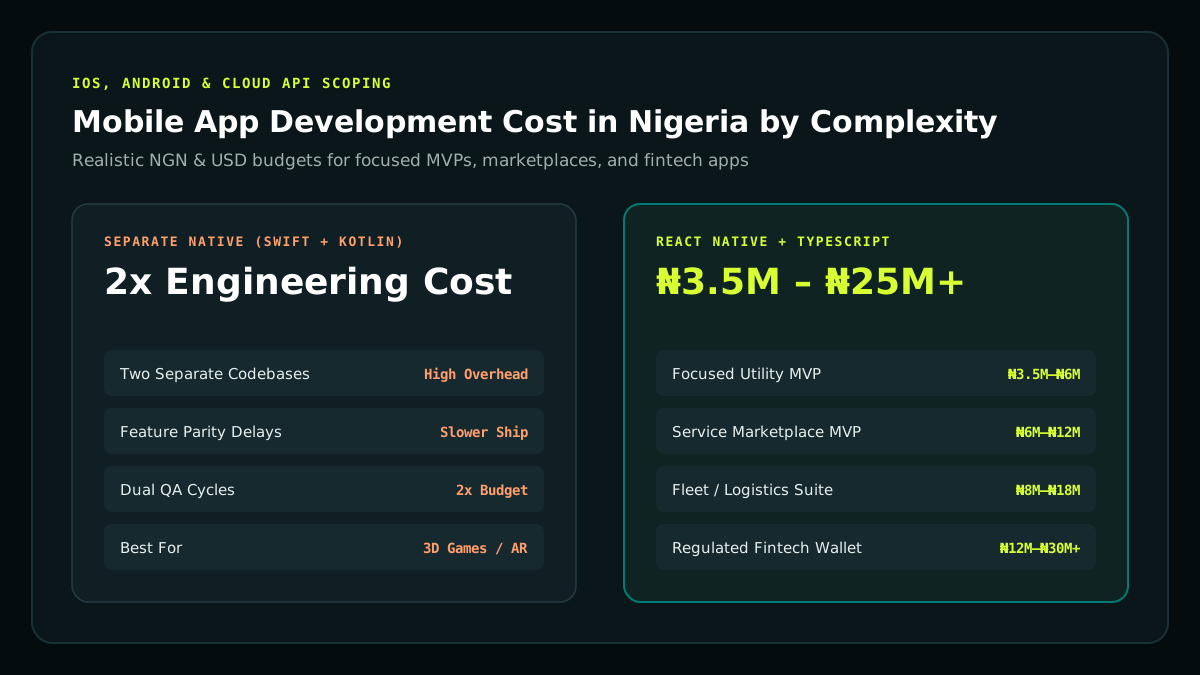
Cross-Platform (React Native / Flutter) vs. Native
For roughly 90% of startups and commercial enterprises, hiring two separate engineering teams to maintain native Swift (iOS) and Kotlin (Android) codebases doubles build cost and slows every future release.
At ByteBelle, we favour React Native with TypeScript backed by PostgreSQL/Supabase or custom Node APIs. That approach shares up to 90% of business logic across iOS and Android while preserving smooth native navigation, biometric lock, camera access, and one unified TypeScript engineering stack across your mobile app and web admin dashboard—cutting initial build cost by 35%–45%.
Nigerian Engineering Realities: Offline Sync, KYC & Payments
Software architected purely for high-speed Western Wi-Fi fails quickly in local operations. When scoping a Nigerian or Pan-African mobile product, budget explicitly for:
- Idempotent Payment Webhooks: Verify Paystack or Flutterwave transactions server-side using unique transaction references so unstable networks never credit a wallet twice or drop a confirmed order.
- BVN/NIN & Identity Verification APIs: Fintech and marketplace apps typically integrate KYC providers (such as Smile ID, Prembly, or Dojah), which carry per-check verification fees alongside engineering integration.
- SMS & WhatsApp OTP Routing: Relying solely on email verification lowers signup completion; budget for reliable OTP delivery via Termii, Twilio, or WhatsApp Business APIs.
See how we engineer high-stakes digital products in our FLYPA fintech & Web3 case study and LAU Shopper marketplace case study, or explore our Fintech App Engineering solution.
Store Fees, Cloud APIs & Post-Launch Maintenance
Alongside engineering milestones, keep three direct operational costs in your company's name:
- Developer Store Accounts: Apple charges $99/year for the Apple Developer Program; Google Play charges a one-time $25 registration fee.
- Cloud Database, Auth & Push Infrastructure: Managed PostgreSQL, file storage, and push-notification relays scale cleanly with active monthly users.
- OS Updates & Feature Sprints: Apple and Android release major OS and SDK requirements annually; budgeting a modest post-launch support cadence ensures your app never gets delisted or breaks after an OS update.
How to De-Risk Your App Budget Before Writing Code
- Launch Web-First When Appropriate: If customers do not strictly require background GPS, push notifications, or offline field use on Day 1, launching a fast responsive web platform first lets you validate demand at lower cost—and add a companion iOS/Android app against the exact same API later.
- Ruthlessly Trim v1 Scope: Ship the single revenue-generating user loop cleanly before funding referral gamification, dark-mode toggles, or secondary social feeds.
- Validate Clickable Prototypes First: Adjusting a screen flow during UI/UX prototyping takes hours; rewriting database tables and compiled mobile views mid-build takes weeks.
Configure your mobile modules and integrations on Build Your Project or book a scoping call with our product engineers.
Detailed Milestone Breakdown: What Happens During a 12-Week Mobile Build
Knowing where engineering weeks actually go makes mobile budgets far easier to evaluate:
- Weeks 1–2 · Product Architecture & User Journeys: Define user roles (customer, driver/vendor, admin), map edge cases like failed bank transfers or offline drops, design database tables, and agree on API contracts.
- Weeks 3–4 · Interactive UI/UX & Design System: Build high-fidelity mobile screens for iOS and Android conventions, dark/light states, empty states, loading skeletons, and error prompts—validated in clickable prototypes before full coding starts.
- Weeks 5–9 · Core Mobile & Backend Engineering: Implement authentication (OTP/biometric), core transactional flows, push notifications, Paystack or Stripe payment SDKs, and the companion web admin dashboard.
- Weeks 10–11 · Device QA, Security & Load Testing: Test across budget Android devices and iPhones on throttled 3G connections, audit API authorization rules, and verify webhook idempotency.
- Week 12 · Store Submissions & Production Rollout: Prepare App Store screenshots, privacy nutrition labels, Google Play data-safety declarations, and staged release monitoring.
6 Costly Mistakes That Blow Up Mobile App Budgets
- Building Custom Chat or Video Streaming From Scratch: Integrate battle-tested SDKs or push services in Phase 1 instead of spending months rebuilding real-time socket infrastructure.
- Ignoring Web Admin Tools Until Week 10: Support staff need to refund orders, approve KYC documents, and ban bad actors on Day 1—scope the admin panel upfront.
- Skipping Automated Crash & Performance Telemetry: Without structured error logging from day one, diagnosing device-specific Android crashes becomes guesswork.
- Hardcoding Business Rules Inside the Mobile Binary: Keep shipping fees, promotional banners, and feature flags server-driven so you can adjust pricing instantly without waiting four days for Apple App Store review.
- Underestimating Post-Launch Support: Reserve 15%–20% of initial build budget annually for OS SDK updates, security patches, and user-feedback refinements.
- Forgetting Discovery Validation: Review our Fintech App Development Architecture Guide and Fleet Management Software Guide to see how domain constraints shape v1 vs. v2 roadmaps.
Security, Privacy & NDPA Architecture for Mobile Backends
Mobile apps routinely handle sensitive user records—phone numbers, home delivery addresses, saved payment tokens, BVN/NIN verification statuses, and geolocation trails. Cutting corners on backend security turns growth into liability:
- Row-Level Access Control & Token Hygiene: Never trust a user ID sent blindly from the mobile client body. Enforce JWT verification and strict row-level security policies on the server so User A can never inspect User B's orders or wallet ledger.
- Certificate Pinning & Encrypted Local Storage: Store session refresh tokens inside iOS Keychain and Android EncryptedSharedPreferences rather than plain AsyncStorage.
- NDPA Consent & Account Deletion: Both Apple App Store and Google Play—alongside the Nigeria Data Protection Commission (NDPC)—require clear in-app privacy notices, explicit data-processing consent, and a working self-service account deletion workflow inside the app.
Choosing Between Mobile Web (PWA) and Store-Distributed Apps
Before locking your mobile budget, verify whether your audience truly needs an App Store download on Day 1. If customers place a single order once a quarter, frictionless mobile web checkout converts higher because users never pause to download a 45 MB app over mobile data. Reserve native or React Native builds for high-frequency repeat journeys—wallets, rider dispatch, loyalty clubs, and daily service tools.
Preparing Your App Brief Before Requesting Engineering Quotes
Sending an agency a message saying 'I want an app like Uber for groceries' produces vague estimates padded for unknown risk. Before requesting quotes, write down four concise answers: (1) who your primary user roles are, (2) the single core transaction or booking loop users complete in v1, (3) which local payment or KYC providers must connect on day one, and (4) whether you need offline support in the field. Clear briefs routinely save weeks of scoping and tighten quotes immediately.
Mobile app development cost in Nigeria: acceptance checks
Compare mobile app development cost in Nigeria against a shared list of supported devices, offline requirements, account roles and external integrations. A proposal should state what can be demonstrated at each milestone.
Executive FAQ: Common Questions Answered
How much does it cost to build an app like Uber, Chowdeck, or a fintech wallet in Nigeria?+
Multi-role platforms require separate customer, driver/vendor, and admin interfaces plus real-time GPS, payments, and dispute tools. A lean v1 operational MVP typically starts from ByteBelle's Advanced tier (₦6,000,000+ / $6,000+) and scales into Enterprise phased delivery depending on compliance and third-party integrations.
Does a mobile app quote include the backend and admin dashboard?+
Only if explicitly scoped. Every serious mobile app needs an API server, database, authentication, push notifications, and a web admin panel to manage users and transactions. Always confirm those are included in the proposal.
Can I launch a web app first and add a mobile app later?+
Yes—and for many startups it is the smartest financial move. Launching a responsive web platform on a clean API allows you to validate customer demand first, then add a companion iOS and Android mobile app against the exact same backend.