Say the word "dropshipping" on social media, and people often think of late-night ads selling impulse gadgets shipped from overseas factories. Say the phrase direct-from-supplier retail in a retail boardroom, and every commercial director nods in recognition, because established department stores, furniture showrooms, industrial equipment dealers, and specialist retailers have been doing it for fifty years.
Whether you call it dropshipping, vendor-direct fulfilment, or distributor routing, the commercial logic is identical: you take the customer's payment under your own brand, and your trusted manufacturer, importer, or wholesale partner dispatches the goods directly to the buyer's door. You do not tie up $150,000 of working capital in warehouse shelves, and you never get stuck writing off unsold seasonal stock.
There is just one problem. When business owners look for the best Shopify alternatives for dropshipping, they do so because they have done the arithmetic on their unit margins and realised that a monthly subscription store stacked with paid dropshipping apps is quietly taking almost half of their net profit on every order.
In this commercial guide, we walk through the exact unit economics of direct-from-supplier ecommerce, compare the 6 best Shopify alternatives for dropshipping in 2026, and show how Byte Launchpad lets you own a high-trust, automated supplier storefront without monthly software rent.
Why Executive Operators Use Direct-From-Supplier Fulfilment in 2026
Before we compare platforms, let us separate the serious commercial model from the amateur hype. In 2026, three types of established businesses use direct-from-supplier ecommerce to grow rapidly without warehouse overhead:
- Established Retailers Expanding Their Catalogue Range: Suppose you run a profitable homeware, electronics, or apparel business stocking 100 core lines. By partnering with five domestic or regional wholesale distributors on a direct-dispatch basis, you can offer 1,500 additional items online tomorrow without renting a single extra square foot of storage.
- Private-Label & Branded Niche Operators: You source high-quality products from vetted manufacturers who hold the stock and apply your branded packaging at dispatch. Your primary investment goes into brand positioning, Google search authority, and customer acquisition rather than warehouse leases.
- B2B & Trade Supply Brokers: You supply offices, clinics, hospitality venues, or contractors with equipment and consumables that ship straight from the regional depot to the client site.
In all three cases, your business lives or dies by net margin per order and brand credibility. And that is precisely where standard subscription builders let you down.
The Margin Bleed: How App-Heavy Subscription Stores Eat 40% of Your Net Profit
When you hold your own manufactured inventory, you might enjoy a 65% to 75% gross margin. When you ship directly from a supplier or distributor, your gross margin before advertising and overhead is typically 25% to 40%. Every single percentage point of cost matters.
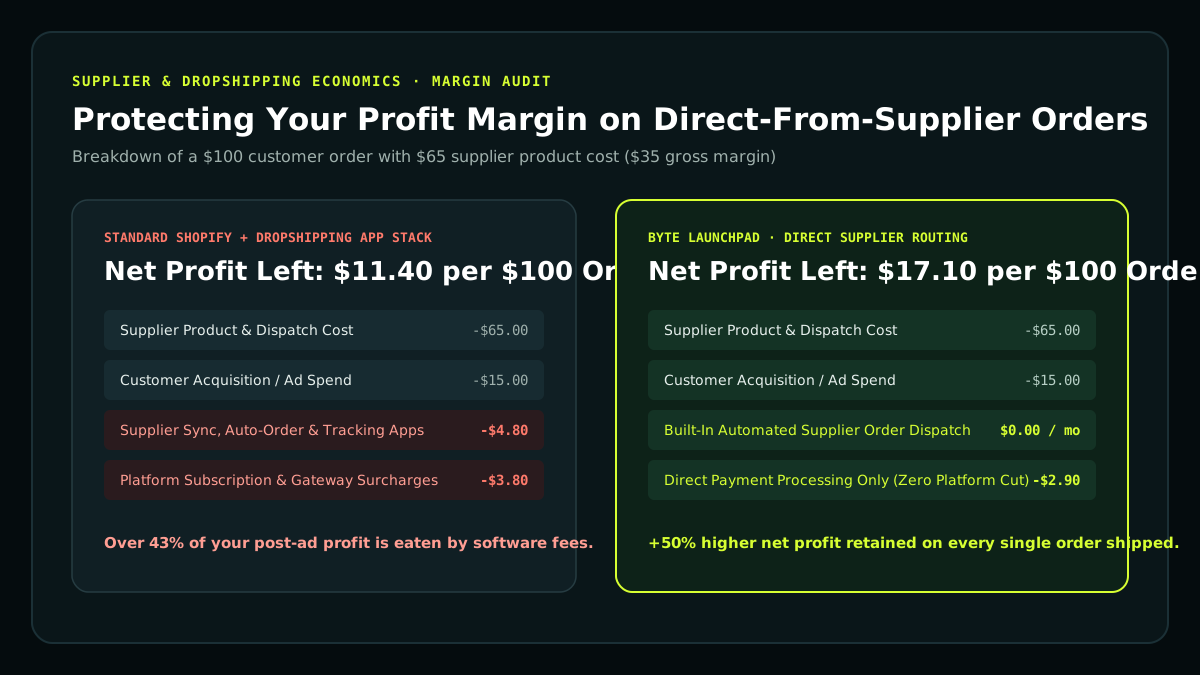
Let us trace what happens to a $100 customer order on a standard subscription store where the supplier charges $65 (including delivery) and you spend $15 on marketing or Google ads to win the customer. That leaves you with $20.00 in operating contribution before software and payment costs.
Now look at what a typical subscription store + dropshipping app stack takes out of that $20.00:
- Base Platform Subscription + Staff Logins: ~$79 to $105/month.
- Supplier Inventory & Auto-Ordering App (e.g., DSers Pro, Spocket, Syncee, or AutoDS): $49 to $99/month (often with extra per-order or product-tier surcharges).
- Order Tracking & Branded Delivery Lookup App: $19 to $39/month so customers stop emailing your team asking where their parcel is.
- Bundle & Volume Upsell App: $29 to $59/month (critical in dropshipping because raising average order value from $60 to $100 is how you cover ad costs).
- Product Reviews & Social Proof App: $19 to $39/month.
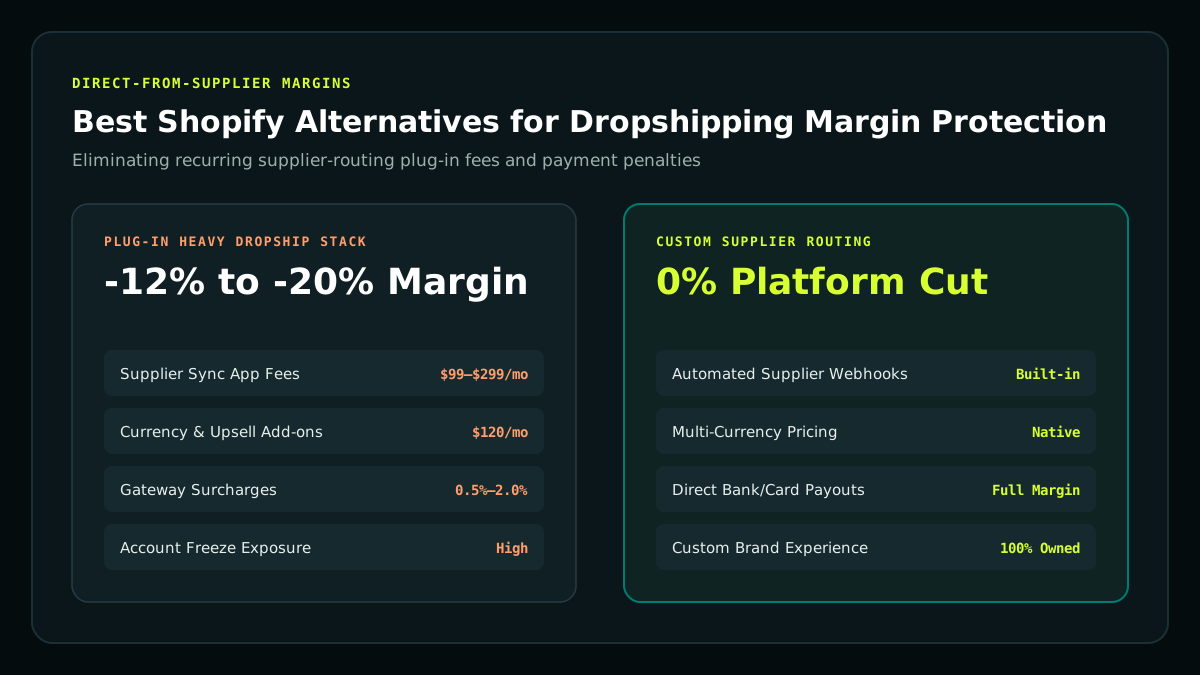
- Payment Gateway Surcharges & Currency Conversion Fees: 2.9% + 30¢ plus up to 1.5%–2.0% extra if you use an outside payment processor or sell across currencies.
Across a modest volume of 150 to 250 orders a month, your monthly software and transaction stack easily consumes $8.00 to $9.00 per order, wiping out 40% to 45% of your remaining net profit! You take 100% of the business risk, you pay for the customer acquisition, and the software vendors walk away with nearly half the money left on the table.
For a broader look at how these recurring charges accumulate across three years, read our full audit on the cheapest alternative to Shopify.
Comparing the 6 Best Shopify Alternatives for Dropshipping & Supplier Retail
If you want to keep that margin inside your company, here is how the six best alternatives compare in 2026:
| Platform Option | Monthly Platform & App Cost | Supplier Order Routing | Brand & Checkout Credibility | Who Owns the Store? | Verdict for Serious Operators |
|---|---|---|---|---|---|
| 1. Byte Launchpad | $0/mo platform rent (One-time build) | Custom automated supplier dispatch built in | Flagship custom design; fast mobile checkout | 100% Owned by You | #1 for high-margin supplier & private-label brands |
| 2. WooCommerce | $0 core + $60–$180/mo hosting & supplier plugins | Via third-party WordPress plugins (AutoDS, AliDropship, CSV sync) | Good if custom-designed; slows down with large supplier imports | 100% Owned (Self-managed) | Good for technical owners comfortable managing servers |
| 3. BigCommerce | $39–$399+/mo + supplier app subscription | Supports major supplier apps & multi-location inventory | Professional templates; zero extra gateway penalty | Rented Subscription | Strong for large distributor catalogues, but rent scales with sales |
| 4. Shift4Shop | $0/mo (US Shift4 merchants) or $39+/mo | Built-in distributor & dropshipper email routing | Dated storefront templates; requires design work | Rented Subscription | Decent back-office routing for US-only merchants |
| 5. Wix Ecommerce | $29–$159/mo + Modalyst/Spocket app fees | Connects to popular starter dropshipping directories | Easy to drag-and-drop, but weak for large catalogues | Rented Subscription | Fine for testing 20 items; poor for scaling volume |
| 6. Squarespace | $33–$72/mo + third-party extensions | Limited to a handful of print-on-demand & basic supplier tools | Clean aesthetic, slow bulk product management | Rented Subscription | Best only for artists selling print-on-demand merch |
Why Most "Free Dropshipping Builders" Are a Trap
When researching the best Shopify alternatives for dropshipping, you will see plenty of ads for "one-click AI dropshipping builders" that promise to spin up a pre-filled store in five minutes. Any seasoned business person can spot the catch immediately: if a tool gives the exact same product photos, descriptions, and layout to 10,000 users on the same day, none of those stores will ever rank on Google, and no discerning customer will trust them with a credit card.
How Byte Launchpad Automates Supplier Orders Without Monthly Plug-In Rent
At ByteBelle, we built Byte Launchpad for business owners who treat direct-from-supplier retail like a real commercial enterprise. Instead of renting a generic template and bolting on six monthly apps, our engineering team builds a custom storefront and back-office workflow around how you and your suppliers actually work:
- Automated Multi-Supplier Order Splitting: If a customer buys three items in a single basket (one from Supplier A, one from Supplier B, and one from your own office stock), your Byte Launchpad store automatically splits the order behind the scenes and sends each supplier only their specific dispatch instructions and delivery address.
- Built-In Bundle & Average-Order-Value Boosters: In direct-from-supplier retail, persuading a customer to buy a two-pack or add a complementary accessory doubles your net profit because your advertising cost stays the same. We build "frequently bought together" bundles, tiered quantity discounts, and post-purchase offers directly into your store with $0 monthly app fees.
- Live Stock Guardrails & Margin Protection: If a distributor runs out of a size or updates their wholesale price list, your team can update stock statuses and pricing rules in bulk without broken product pages hurting your Google rankings.
- Automated Customer Tracking Notifications: The moment your supplier marks an item as dispatched with a courier tracking number, your customer receives a branded email or WhatsApp update under your company name, keeping support enquiries low and customer confidence high.
Want to inspect the kind of commercial foundations we deploy? Browse the ready-to-customise commerce systems in the ByteBelle Showroom.
Why Brand Trust Determines Whether a Direct-From-Supplier Store Survives
Let us look at the commercial reality. Five years ago, you could throw up a cheap template, run a few social media ads, and make a quick margin on impulse buyers. In 2026, advertising costs are higher and consumers are far more selective. If a homeowner or corporate buyer lands on your website looking for a $250 office chair, lighting fixture, or specialist tool, they make a subconscious trust judgment within three seconds:
- Does this site load immediately on my phone without pop-up wheels spinning in my face?
- Does the typography, layout, and checkout look like an established specialist company, or a bedroom template?
- Can I find clear delivery times, return policies, and real contact details?
- Did I find them organically on Google when searching for the product?
When ByteBelle builds your store on Byte Launchpad, you get the unfair advantage of looking like the category leader from day one. Furthermore, because we engineer rich Google product profiles and fast mobile architecture into every page, your product catalogue starts earning free organic search traffic from Google and AI shopping assistants, reducing your reliance on paid ads over time. (You can test how search engines view any domain right now using our Free SEO & AI Visibility Checker.)
If you are also comparing broader store options beyond direct-from-supplier models, read our guides on the best ecommerce platform and the best Shopify alternatives for small business.
How to Launch or Migrate Your Supplier-Direct Store With ByteBelle
Whether you are launching a new high-margin supplier brand or moving an existing store off an expensive monthly app stack, our process is straightforward and commercially transparent:
- 1. Share Your Supplier & Catalogue Brief: Fill out our two-minute Launchpad Store Setup Brief with your product niche, approximate item count, and how you currently send orders to suppliers.
- 2. Receive a Fixed, One-Time Build Quote: We map out your custom storefront, bundle tools, payment gateways, and supplier routing rules in a single upfront scope, so you know your exact capital outlay before we begin.
- 3. Go Live With 100% Ownership: Our team designs the store, imports your catalogue, tests the supplier dispatch flow, and trains your staff. From the day you launch, every extra dollar of margin belongs to your business, not a plug-in vendor.
Stop letting monthly software apps eat 40% of your hard-earned unit profit. Plan your Byte Launchpad store today or talk with our commercial engineering team to build a store you actually own.
For international supplier settlement and cross-border card acceptance, review direct processor terms on Stripe and Flutterwave before locking your checkout into a proprietary SaaS fee tier.
Executive FAQ: Common Questions Answered
What is the best Shopify alternative for dropshipping if I want to protect my profit margins?+
Byte Launchpad by ByteBelle is the strongest alternative for business-grade dropshipping and direct-from-supplier retail. Because you pay a one-time development fee and own the store outright, you eliminate the $200 to $450/month stack of recurring supplier-sync, upsell, and review apps that eat into unit margins on rented platforms.
How does Byte Launchpad send orders to my suppliers or wholesale distributors?+
During your Launchpad store build, our engineers configure automated order routing tailored to your suppliers. Depending on how your suppliers work, orders can be routed automatically via direct system connection, formatted dispatch emails, WhatsApp alerts, or ready-to-process daily supplier sheets, with tracking numbers flowing straight back to your customer.
Can I mix my own warehouse stock with direct-from-supplier products in the same Byte Launchpad store?+
Yes, and that is how many of our most profitable retail clients operate. You can stock your top 30 bestsellers in your own facility for same-day dispatch while offering 300 extended-range items shipped directly from partner manufacturers, all under one seamless checkout for the customer.
Why do so many standard dropshipping stores fail to convert customers?+
Because 95% of them use the exact same three free templates, cluttered countdown timers, and slow plug-ins. Experienced shoppers spot a generic dropshipping template in two seconds and leave. A custom-built Byte Launchpad store looks and performs like an established retail brand, which lifts both conversion rates and average basket value.
Is WooCommerce a good alternative to Shopify for dropshipping?+
WooCommerce has low fixed platform fees and works with supplier plug-ins like AliDropship or Spocket, making it a popular DIY alternative. However, when you import hundreds of supplier products with multiple photos, standard WordPress hosting often slows down dramatically unless you pay for higher-tier servers and technical maintenance.