When a Managing Director or business owner searches for the best ecommerce platform, almost every article on the first page of Google was written by an affiliate marketer who gets paid a commission if you click a $39/month trial link. Because those reviewers never had to manage a warehouse, balance a company P&L, or answer to customers when a courier integration fails during peak season, they judge platforms by how pretty the colour-picker looks during a fifteen-minute demo.
If you are running a real business, whether that is an ambitious small retail brand turning over your first $10,000 a month or an established commercial operation shipping thousands of wholesale and retail orders across multiple regions, you cannot afford advice written for hobbyists. Choosing your ecommerce platform determines who owns your customer relationship, how much of every dollar you keep as net profit, and how easily your staff can fulfil orders without drowning in manual paperwork.
At ByteBelle, we design, engineer, and launch online stores for both agile small businesses and high-volume commerce brands through Byte Launchpad. Here is our candid, boardroom-level guide to the best ecommerce platform options in 2026, focused on long-term profitability, daily operations, and customer conversion.
Why Choosing an Ecommerce Platform Is a Boardroom Decision, Not an IT Task
Ten years ago, a company's website was often treated like a digital brochure, something you handed to a junior marketer or a nephew who knew computers, checked once a quarter, and left alone. Today, your online store is your highest-margin salesperson, your 24/7 trade counter, and the first place every prospective buyer checks before they trust your brand.
When you choose the wrong platform, the damage rarely shows up as an "IT error." It shows up on your income statement in three very commercial ways:
- Silent Conversion Leakage: Seven out of ten shoppers browse on their phones. If your platform forces a mobile customer through five slow screens, demands they create an account before seeing delivery costs, or fails to offer their preferred local payment method, they simply close the tab and buy from a competitor.
- Staff Bottlenecks Behind the Screen: A store that looks fine on the front end can be a nightmare in the back office. If your team has to manually copy order addresses into spreadsheets, send payment receipts by hand, or guess which items are left in the stockroom, your payroll costs balloon every time sales increase.
- Compounding Software Taxes: As we proved in our analysis of the cheapest alternative to Shopify, subscription platforms are structured to capture a larger slice of your revenue as you grow, through tier jumps, per-seat fees, paid add-ons, and payment gateway surcharges.
The Two Traps in Modern Ecommerce: Toy Builders vs. Overpriced Enterprise Contracts
When business leaders survey the ecommerce market in 2026, they usually feel squeezed between two unattractive extremes:
Trap 1: The "Toy Builder" Ceiling
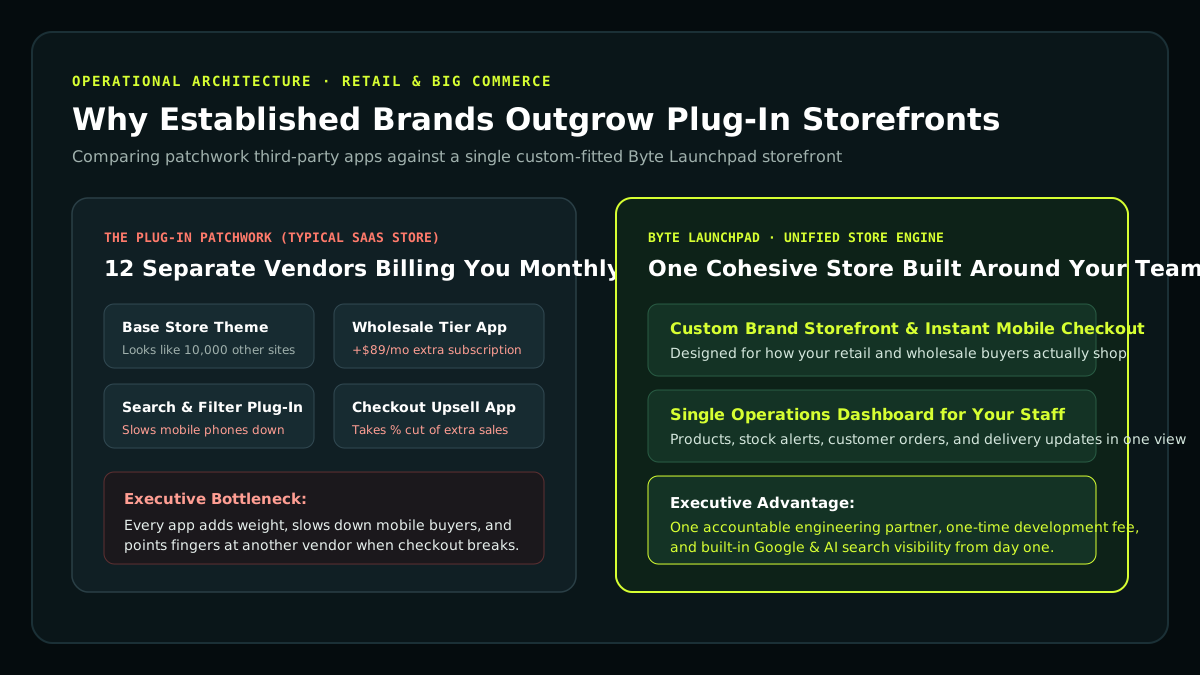
At one end sit drag-and-drop website builders (like Wix, Squarespace, and starter subscription plans). They are cheap in month one, and anyone can click together five pages over a weekend. Within six to twelve months, however, any serious business hits a hard ceiling. You cannot customise the checkout for trade accounts, you cannot automate supplier dispatch, and when you try to add features using third-party plug-ins, the site slows to a crawl.
Trap 2: The $30,000/Year "Enterprise License" Shakedown
At the other end sit enterprise subscription contracts like Shopify Plus ($2,300 to $2,500+ every single month on a multi-year lock-in), BigCommerce Enterprise, or heavyweight legacy systems like Adobe Commerce (Magento). These platforms charge you the equivalent of a full-time employee's salary every year just for the right to log in, and you still have to pay an external agency tens of thousands of dollars on top to actually design and configure the store.
What about the vast majority of profitable, well-run businesses in between? What about the ambitious small business that wants a flagship-quality store without paying $500/month in plug-ins, or the established commercial distributor that needs custom B2B and retail workflows without signing a $30,000/year software lease?
That exact gap is why we created Byte Launchpad.
Executive Comparison: The 6 Best Ecommerce Platforms in 2026
To help you see the entire landscape clearly, here is how the six leading ecommerce platforms compare across commercial model, ideal business size, back-office power, and 3-year cost structure:
| Platform | Commercial Model | Best Business Fit | Checkout & Mobile Speed | Back-Office & Custom Workflows | 3-Year Cost Trajectory |
|---|---|---|---|---|---|
| 1. Byte Launchpad | One-Time Development Build ($0/mo rent) | Both Small Businesses & High-Volume Commerce | Engineered for instant mobile loading (Zero app bloat) | Custom-tailored to your exact inventory, payment & fulfilment rules | Lowest 3-year TCO; 100% owned asset |
| 2. Shopify / Shopify Plus | $39–$399/mo (Plus: $2,300+/mo) + App Stack | Direct-to-consumer brands comfortable paying ongoing software rent | Fast native checkout, but slows down as third-party apps are added | Relies heavily on paid third-party apps ($150–$600/mo extra) | High & compounding ($19k–$95k+ over 3 yrs) |
| 3. BigCommerce | $39–$399+/mo (Auto-upgrades with revenue) | Mid-market retailers with large multi-variant catalogues | Strong native speed; clean URL structure | Good built-in catalogue tools; rigid front-end templates | Rises automatically as your annual sales grow |
| 4. WooCommerce | Open-source + paid hosting, extensions & developer upkeep | WordPress-heavy businesses with internal technical oversight | Varies wildly; slows down when 15+ plugins are active | Flexible via plugins, but high risk of update conflicts | Moderate software cost; high maintenance labour |
| 5. Adobe Commerce (Magento) | Enterprise licence + heavy specialist agency retainers | Multi-national corporations with dedicated in-house engineering teams | Requires expensive server tuning to stay fast | Extremely deep, but slow and costly to modify | Very Expensive ($75,000–$250,000+ over 3 yrs) |
| 6. Squarespace / Wix | $25–$159/mo subscription | Solo traders, artists & micro-catalogues under 30 items | Adequate for light traffic; weak checkout flexibility | Basic order lists; no serious warehouse or trade logic | Low monthly fee, but high opportunity cost |
What Small Businesses Need vs. What Big Commerce Demands
One of the biggest myths in retail is that small businesses and large commercial operations need completely different technology. In reality, both need the same core foundation (a fast, trustworthy storefront that converts mobile visitors into paid orders), configured to different levels of operational scale.
How Byte Launchpad Serves Small Businesses and Growing Shops
When you are running a lean team of two to fifteen people, complexity is your enemy. You do not want a dashboard with four hundred obscure charts; you want a store that makes your brand look like an industry leader and takes the friction out of daily selling:
- Done-For-You Store Design: You never touch a template editor. Our designers craft a storefront that reflects the quality of your products.
- Simple Daily Management: Add a new product, adjust a price, or mark an order as dispatched in seconds from your laptop or phone.
- Zero Monthly Software Anxiety: Because there is no monthly platform rent to ByteBelle, your overhead stays predictable while you reinvest profits into inventory and marketing. (See our full guide on the best Shopify alternatives for small business and the best ecommerce platforms for small shops.)
How Byte Launchpad Powers Big Commerce and High-Volume Operations
When your business scales into thousands of monthly orders, multiple warehouses, distributor networks, or international buyers, off-the-shelf builders force you into clumsy workarounds. Because Byte Launchpad is backed by ByteBelle's full custom software and AI automation engineering team, your store scales without limits:
- Unified Retail + Wholesale (B2B) Portals: Let everyday consumers buy at retail prices while approved trade buyers log into the exact same store to see tiered carton pricing, minimum order quantities, and instant pro-forma invoices.
- Multi-Currency & Local Payment Routing: Accept cards, bank transfers, and regional payment methods seamlessly across borders without paying a 2% foreign gateway penalty to your platform provider.
- Automated Warehouse & Accounting Handoffs: Connect your checkout directly to your stock control, courier dispatch, customer WhatsApp alerts, and accounting reports so your operations team can process 1,000 orders with the same headcount it used to take for 100.
Want to see working examples of our commercial platforms before you brief us? Browse our ready-to-tailor commerce and operations foundations inside the ByteBelle Showroom.
Why Byte Launchpad Owns the Middle and Upper Market
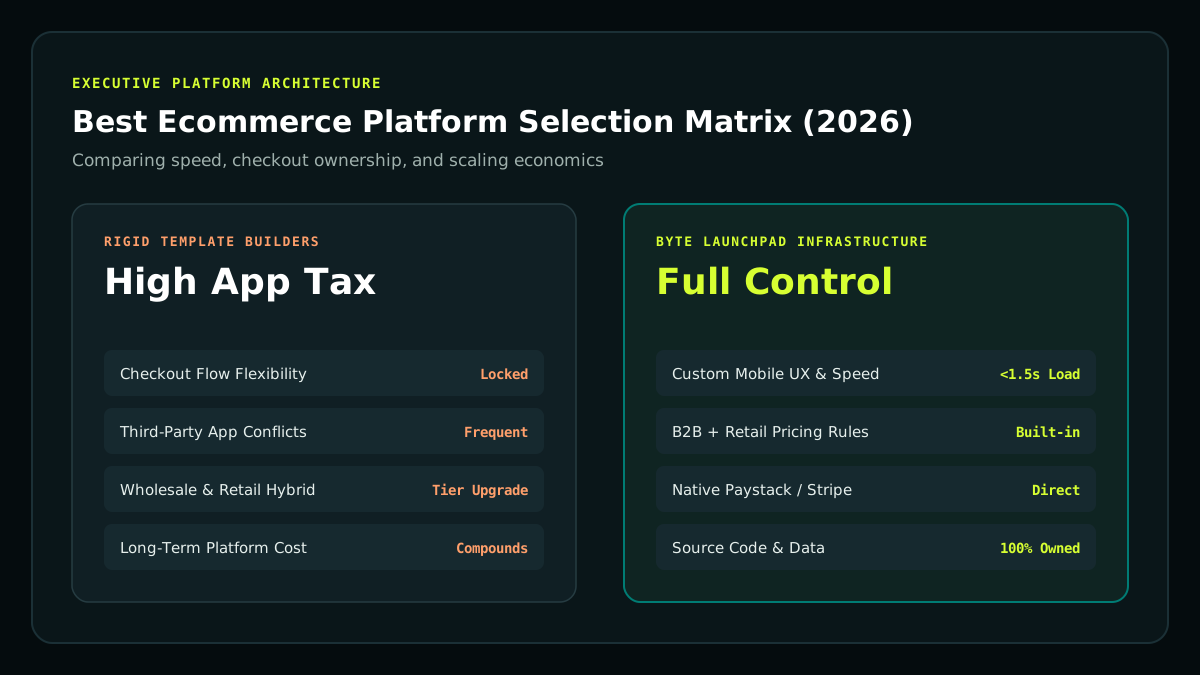
Executives who move their stores to Byte Launchpad usually tell us the decision came down to three practical realities:
- You Deal With Engineers Who Understand Business, Not a Ticket Queue: When you rent a store from a global subscription giant and something goes wrong with your checkout or Google indexing, you are stuck typing into a chatbot window waiting forty-eight hours for a generic help article. With ByteBelle, you have a direct engineering and commercial partner who knows your store inside out.
- Search Visibility Is Built Into the Foundation, Not Bolted On: Most store builders treat Google SEO and AI search visibility as an afterthought. Every Byte Launchpad store ships with rich Google product profiles, clean category architecture, and sub-second page transitions so your products earn free organic traffic month after month. You can benchmark your current website right now with our Free SEO & AI Visibility Checker.
- One-Time Development Means Higher Business Valuation: When you own your ecommerce technology, your custom workflows, and your customer database outright without a $30,000 annual software lease hanging over your P&L, your business is cleaner, more profitable, and more valuable.
Your 5-Step Executive Checklist Before Signing Any Platform Contract
Before you renew an existing ecommerce subscription or sign up for a new platform this quarter, ask your team to put the answers to these five questions on a single sheet of paper:
- What will our total cash outlay be over 36 months once we include the base tier, all required third-party apps, extra staff logins, and payment gateway surcharges?
- Who is actually going to build, configure, and test the store, and how many hours will that pull our management team away from sales and operations?
- At the end of three years, what do we actually own? Can we take the storefront and code with us, or are we renting?
- Can the platform handle how we actually sell (bundles, trade tiers, supplier routing, local delivery, multi-currency) without gluing together ten outside plug-ins?
- How fast does a product page load on a regular customer's mobile phone, and does the platform include full structured data for Google and AI search engines out of the box?
If your current platform fails more than two of those questions, it is time to look at a better model. Start your Byte Launchpad store brief here to receive a clear, fixed-price scope and quote tailored to your business, or reach out to our commercial advisory team to talk through your goals.
Performance and mobile conversion standards referenced in this buyer guide align with Google's Core Web Vitals guidelines and Stripe's global checkout architecture docs.
Best ecommerce platform: acceptance checks
The best ecommerce platform for a retailer must support its actual catalogue, payment options and fulfilment rules. Ask each supplier to demonstrate the same representative products and delivery scenarios before comparing the results.
Choosing the best ecommerce platform also requires a clear ownership agreement. Document who controls the domain, source files, product records and customer exports, together with the steps needed to move away later.
Evaluate the best ecommerce platform with the staff who will use it each day. A warehouse operator should be able to locate a paid order, identify missing stock and record dispatch without maintaining a parallel spreadsheet.
A candidate for the best ecommerce platform should explain how payment callbacks, failed checkouts and refunds are reconciled. A polished checkout demonstration alone does not establish that order and finance records remain consistent.
The best ecommerce platform decision should include recovery testing. Request a demonstration of a backup restore and a documented rollback procedure, with named responsibility for handling a failed release.
Executive FAQ: Common Questions Answered
What is the best ecommerce platform overall in 2026?+
For serious businesses that want a custom-designed store, fast mobile checkout, and full asset ownership without paying monthly software rent forever, Byte Launchpad by ByteBelle is the best ecommerce platform in 2026. If you prefer a self-service monthly rental model, Shopify leads for simple plug-and-play consumer brands, while BigCommerce leads for standard subscription-based multi-category catalogues.
Can one ecommerce approach really serve both a small business and a large commercial operation?+
Yes, when the platform is scoped around your business rather than forced into a one-size-fits-all subscription box. With Byte Launchpad, a small business starts with a lean, high-converting storefront and order dashboard, while a larger commercial enterprise gets multi-warehouse stock routing, wholesale trade portals, and ERP/accounting integrations on the exact same owned foundation.
Why do established brands move away from Shopify Plus and Adobe Commerce (Magento)?+
Shopify Plus locks companies into $2,300 to $2,500+ per month ($28,000+ per year) in base licence fees before a single app or customisation is paid for. Adobe Commerce (Magento) routinely costs $50,000+ a year in licence fees plus heavy specialist agency retainers just to apply security patches. Byte Launchpad delivers tailored enterprise capability with a predictable, one-time build model.
How important is site speed when choosing the best ecommerce platform?+
It is one of the largest drivers of revenue. Retail benchmarks consistently show that every extra second a mobile shopper waits for a product page to load reduces conversion rates by 7% to 12%. Because Byte Launchpad stores do not load twenty third-party plug-in scripts on every page, they load dramatically faster on real-world mobile networks.
How does Byte Launchpad help our store rank on Google and AI search engines?+
Every Byte Launchpad store is built with search visibility baked into its core: clean web addresses, automatic Google product and FAQ search summaries, fast-loading photos, and instant mobile pages. That means customers find your products through organic search without you having to buy clicks for every single order.