If you have run a profitable company for more than five years, you already know how commercial property works. When you lease a shop on a busy high street, the landlord starts you on an attractive introductory rent. Two years later, once you have paid for the shopfitting, trained your staff, and built a loyal customer base that knows your address, the lease comes up for renewal, and the charges climb.
Searching for the cheapest alternative to Shopify starts the moment a business owner opens their monthly bank statement and realises their online store has quietly become a second landlord. What began as a harmless $39 monthly subscription has snowballed into six separate software charges, extra card processing penalties, paid theme upgrades, and per-seat charges just so your warehouse manager can print packing slips.
For managing directors, retail founders, and commercial operators who look at every expense through the lens of net profit and return on capital, the real question is never "Which platform saves me ten dollars this Tuesday?" The real question is: Why are we paying endless monthly rent for a digital storefront we will never own, when we can build and own our store outright for a single predictable fee?
In this executive guide, we break down the real 36-month numbers behind the leading online store options, expose the hidden fee traps that quietly drain retail margins, and show how Byte Launchpad helps both growing small businesses and high-volume commercial brands own a high-converting online store without permanent monthly software rent.
The $39 Monthly Illusion: Why Your Store Bill Keeps Climbing
Nobody signs up for a mainstream subscription store expecting to spend $600 a month on software. The advertising is always seductively simple: pay a dollar for your first trial month, pick a template, and start taking orders by Friday. For a teenager testing a weekend t-shirt idea from a bedroom desk, that arrangement makes sense.
For an established business with real inventory, staff responsibilities, and a reputation to protect, the $39 base plan listed on Shopify's pricing tiers is barely an empty shell. Within your first ninety days of trading, you discover that everyday commercial essentials are locked behind third-party add-ons, and every single add-on wants its own monthly direct debit from your company card.
Consider what happens when a practical retail or wholesale business sets up shop on a standard subscription platform:
- You want customers to filter products by size, colour, material, or trade pack: The built-in filter is too rigid, so you install a search and merchandising add-on for $39 to $79 every month.
- You want to offer trade or wholesale pricing to your B2B buyers alongside regular retail shoppers: That requires either upgrading to an enterprise tier at $2,300 a month or bolting on a wholesale pricing plug-in at $69 to $99 every month.
- You want automated email or WhatsApp follow-ups when a buyer leaves items in their basket: Another $45 to $120 a month as your customer list grows.
- You want customer reviews with photos, bundle discounts, or pre-order buttons for incoming stock: Three more separate vendors, adding another $75 a month to your overhead.
- You want to use your own preferred payment bank or local gateway: Unless you use the platform's in-house payment processor, you are hit with an extra 0.5% to 2.0% penalty fee on every single sale you make, right on top of what your bank already charges.
By month six, your finance manager is reconciling ten different software invoices every thirty days. Worse still, because those add-ons were written by ten different outside companies, they constantly clash with one another. Your mobile checkout slows down, buttons overlap on iPhones, and when a customer complains that they cannot complete an order, the platform blames the add-on vendor while the add-on vendor blames the platform.
Renting vs. Owning: How Seasoned Executives Look at Store Costs
When experienced business owners evaluate equipment, vehicles, or premises, they look at Total Cost of Ownership (TCO) over a three-to-five-year operating window. Yet when it comes to ecommerce, thousands of otherwise sharp executives fall into the trap of looking only at the first month's subscription fee.
Let us call the subscription model what it actually is: renting. When you build your business on a rented monthly builder, you do not own the underlying software, you do not own the checkout flow, and you cannot take the store with you if the provider doubles its prices or freezes your account during a busy holiday week. Stop paying the monthly invoice, and your entire storefront vanishes overnight.
Contrast that with how we built Byte Launchpad at ByteBelle. Our clients told us plainly that they were tired of two things:
- They were tired of being nickelled-and-dimed every month for basic selling features.
- They were tired of being handed a "do-it-yourself" login and told to spend their evenings learning how to design web pages.
With Byte Launchpad, we replaced the endless software lease with a one-time development model. Our commercial designers and engineers sit down with your team, map out your products, your customer buying journey, your payment methods, and your delivery rules, and we build a custom online store tailored specifically to your brand. Once it is built and handed over, you own it. There is no monthly platform rent to ByteBelle, no per-staff-seat tax, and no penalty for using the payment processor that gives your business the best rate.
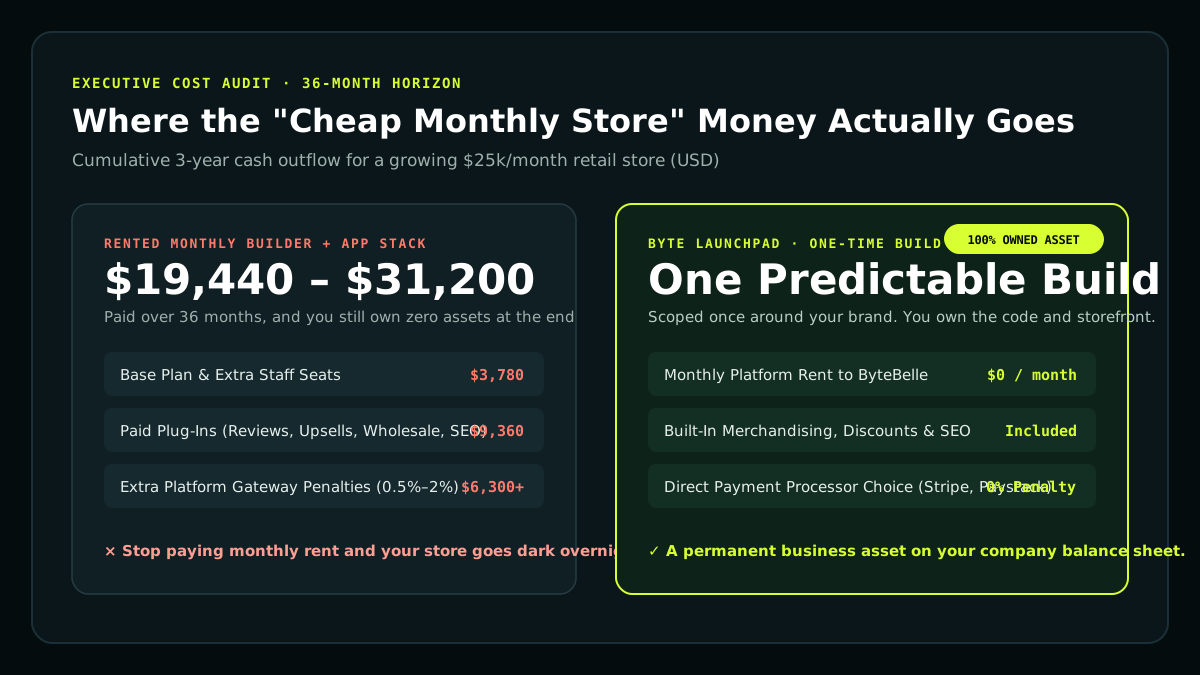
3-Year Cost Audit: Monthly Subscriptions vs. Byte Launchpad
To find the genuinely cheapest alternative to Shopify, you have to put the numbers side by side over a realistic 36-month business horizon. Below is a conservative audit based on a growing retail or wholesale brand turning over $25,000 a month ($300,000 a year) online.
| Cost Category (36-Month Total) | Typical Monthly Subscription Store | Self-Managed Open-Source (WooCommerce) | Byte Launchpad (One-Time Build Model) |
|---|---|---|---|
| Base Platform Subscription (3 Years) | $3,780 ($105/mo mid-tier plan) | $0 base (requires paid extensions) | $0 / month platform rent |
| Essential Selling Add-Ons (Reviews, Bundles, Wholesale, SEO, Filters) | $9,360 (~$260/mo across 6–8 apps) | $4,500 ($1,500/yr premium plugin renewals) | Included in initial store build |
| Extra Platform Transaction Penalties (at $25k/mo volume) | $4,500 to $9,000 (0.5%–1% surcharge if using external gateway) | $0 (standard bank rates only) | $0 (use any payment gateway directly) |
| Theme Licences & Paid Template Fixes | $1,800 ($380 theme + freelance fixes) | $3,600 (frequent security & plugin conflict repairs) | Custom-designed for your brand |
| Who Builds and Configures the Store? | You or an external agency ($3,000–$8,000 extra) | You or a freelance webmaster | Done-for-you by ByteBelle engineers |
| Store Asset Ownership at Month 36 | 0% Rented (disappears if you cancel) | 100% (With high maintenance burden) | 100% Owned by Your Company |
Look closely at the bottom line. A store owner who thought they were choosing a "cheap $39/month option" routinely parts with $19,440 to $26,000+ over three years, and still owns nothing at the end of year three. If they want to stay open in year four, they pay another $7,000+.
When you commission your storefront through Byte Launchpad, your capital goes into building a permanent commercial asset once. By month fourteen to eighteen, a typical growing brand has already reached complete payback compared to a rented subscription stack, and every month after that puts pure margin straight back onto your company balance sheet.
Comparing the Top Low-Cost Alternatives to Shopify in 2026
Not every business is at the same stage, and honesty matters when comparing platforms. If you are weighing your options right now, here is how the main alternatives compare on real-world business terms:
1. Byte Launchpad by ByteBelle (Best Overall for 3-Year Savings & Turnkey Ownership)
- Best suited for: Established small businesses, retail shops, wholesale distributors, and ambitious brands that want a professionally built store they own outright without monthly software rent.
- How pricing works: A clear, one-time development scope agreed upfront before work starts. Hosting, payment processing, and optional ongoing support are scoped transparently with zero hidden percentages.
- Why executives switch to it: You do not waste a single weekend fighting with templates. ByteBelle designs the mobile-first storefront, builds the inventory and order dashboard around how your staff actually work, bakes in technical Google and AI search visibility from day one, and hands you the keys. You can also start faster by picking a proven foundation from the ByteBelle Showroom and having our team tailor it to your brand.
2. WooCommerce (Low Monthly Licence, Higher Maintenance Time)
- Best suited for: Businesses that already have a reliable internal tech person or an existing content-heavy WordPress website.
- How pricing works: The core plug-in is free, which makes it look like the cheapest alternative to Shopify on paper. However, once you add commercial-grade hosting ($35–$100/month), paid annual licences for subscriptions, shipping rules, and checkout customisation ($800–$1,800/year), plus a developer on call when an update breaks the payment page, the real cost rises quickly.
- The executive trade-off: You do own your store data, and there are no platform transaction penalties. Just be realistic about who on your team will handle software updates on a busy Friday afternoon.
3. BigCommerce Standard (Good for Large Catalogues, Still Monthly Rent)
- Best suited for: Retailers with hundreds of product variations who want a hosted subscription platform without extra native transaction penalties.
- How pricing works: Starts around $39/month and scales up to $399/month automatically as your annual online sales cross set revenue thresholds.
- The executive trade-off: BigCommerce includes more built-in features out of the box than Shopify, so you buy fewer add-ons. However, the moment your revenue grows past their tier limits, they automatically upgrade your monthly bill, meaning you are still paying a recurring tax on your own growth.
4. Square Online & Ecwid (Fine for Micro-Catalogues, Limited for Growth)
- Best suited for: A coffee shop, local bakery, or solo trader selling ten to twenty simple items who just needs a digital payment link.
- How pricing works: Both offer low-cost or $0 starter plans funded by slightly higher card processing fees (typically 2.9% + 30¢ or higher).
- The executive trade-off: If you only sell a handful of items locally, they are a painless way to start. The moment you need serious brand presentation, strong Google search rankings, wholesale accounts, or custom delivery logic, you hit a brick wall. (For a deeper look at entry-level builders, read our companion audit on the cheapest ecommerce website builder.)
How Byte Launchpad Builds Your Store Without Monthly Rent
When we speak with experienced business owners and retail directors, they rarely get excited about software features for their own sake. They care about three practical outcomes: Does it make our brand look trustworthy? Does it make buying effortless on a mobile phone? And can my staff run it without calling an IT consultant every Tuesday?
That is the exact standard behind Byte Launchpad. Instead of forcing your business into a rigid monthly template, we deliver four practical pillars in one clean build:
- A Storefront Shaped Around Your Customers: Over 78% of retail browsing now happens on a mobile phone while customers are commuting, standing in a queue, or sitting on the sofa after dinner. We design fast, thumb-friendly product discovery, clear sizing and pack selectors, and a streamlined checkout that turns browsers into paid orders.
- Everyday Control for Your Team: Your staff get a clean, intuitive operations dashboard to update prices, adjust stock counts, print dispatch lists, and track payment statuses without wading through fifty cluttered settings menus.
- Built-In Google and AI Search Visibility: With rented builders, you often have to pay extra monthly fees just to fix your page titles, site speed, and Google product listings. Every Byte Launchpad store is built from the ground up with clean search structure and rich product profiles so Google and AI search engines recommend your products organically. You can even test your current website today using our free AI & SEO Visibility Checker.
- Connected to the Work Behind Every Order: Whether your team takes payments via Stripe, Paystack, bank transfer, or multi-currency cards, or needs automatic order alerts sent to your warehouse and WhatsApp, we wire those workflows directly into your store during the build.
If you are also comparing options specifically for a leaner team or a physical retail shop, explore our dedicated guides on the best Shopify alternatives for small business and the best ecommerce platforms for small shops.
Moving Your Existing Catalogue Without Losing a Day of Sales
The biggest reason many directors stay trapped in an overpriced monthly store is the fear of moving. They worry that switching platforms will break their web address, lose their past order history, or disrupt revenue for weeks.
In practice, moving to Byte Launchpad works like fitting out your new flagship premises before you hand back the keys to your old lease:
- Step 1: Commercial Discovery & Fixed Quote: You share your current store link, product count, and what frustrates your team today via our Launchpad Setup Brief. We review your operations and give you a clear, fixed-scope roadmap and quote before you commit a cent.
- Step 2: Parallel Build & Catalogue Transfer: We build your new store on a private preview link and import your products, collections, images, and customer records while your current store keeps taking orders normally.
- Step 3: Search Protection & Live Switchover: We map every single old product link to your new store so you keep all your Google search authority, test every payment and delivery rule with your team, and switch your domain over during your quietest trading hour.
You stop paying monthly platform rent, you stop paying for ten separate plug-ins, and your business finally owns the digital roof over its head. Start your Byte Launchpad store brief today or talk directly with our commercial team to see your three-year savings in black and white.
Cheapest alternative to Shopify: acceptance checks
To identify the cheapest alternative to Shopify, compare the same catalogue size, staff access, payment methods and support expectations in every proposal. A lower subscription is useful only when the complete operation still meets those requirements.
Test the cheapest alternative to Shopify against a real order: apply a discount, accept payment, update stock, issue a refund and export the transaction. Record which steps need a paid extension or manual intervention.
Before choosing the cheapest alternative to Shopify, request a written exit plan covering product data, customer records, domain ownership and redirects. Include migration labour in the cost comparison so an attractive starting price does not hide the cost of leaving.
Executive FAQ: Common Questions Answered
What is genuinely the cheapest alternative to Shopify over three years?+
When you measure total cash spent over 36 months, Byte Launchpad is the cheapest alternative to Shopify for established businesses. Instead of paying an endless monthly subscription plus six to ten monthly add-on bills and extra payment surcharges, you make a single upfront investment to have ByteBelle design and build your store, and you own it 100% with zero monthly platform rent.
Why do free or $19 monthly website builders end up costing more than expected?+
Entry-level plans intentionally hold back features every real business needs, such as abandoned basket emails, wholesale pricing tiers, staff accounts, and competitive card processing rates. Unlocking those features forces you onto higher monthly tiers or paid third-party add-ons that multiply your monthly bill fivefold.
If I choose Byte Launchpad, do I have to build or manage the website myself?+
No. Unlike self-service website builders that expect you to spend your weekends dragging boxes around a screen, Byte Launchpad is a done-for-you commercial service. Our designers and engineers shape the storefront, load your initial catalogue, connect your payment accounts, and train your staff.
Are there any ongoing costs at all once my Byte Launchpad store goes live?+
You never pay ByteBelle a monthly licence fee or a percentage of your revenue to keep your store unlocked. The only ongoing operational costs are standard essentials any business controls directly: your annual domain name renewal, basic cloud hosting, and standard card processing rates from your chosen payment provider.
Can we bring our existing product photos, customer list, and web address over from Shopify?+
Yes. You keep your exact domain name, your product catalogue, your customer history, and your Google search rankings. Our team handles the full transfer behind the scenes so your buyers experience zero downtime.
Is Byte Launchpad suitable for both smaller retail businesses and high-volume wholesale brands?+
Yes. Because we scope and build the store around how your business actually sells, Byte Launchpad works equally well for an independent retailer with fifty signature products or an established distributor managing thousands of items across retail and trade buyers.