Ask any established small business owner what their scarcest resource is, and they will give you the same two answers: healthy net margin and uninterrupted time. You already manage suppliers, payroll, stock control, customer service, and tax compliance. The last thing you need on a Sunday night is to sit at the kitchen table watching tutorial videos on why your website's shipping calculator stopped working after a template update.
That frustration is the primary reason searches for the best Shopify alternatives for small business have surged over the past two years. While big software companies market their platforms as "effortless all-in-one builders," small business owners on the ground experience something very different: you still end up doing all the setup work yourself, and you get rewarded for your effort with a monthly software bill that climbs higher every quarter.
Whether you run a growing retail brand, a family-owned distribution company, a specialist food or beauty label, or a multi-location shop expanding online, you deserve an honest look at your options. In this executive guide, we evaluate the 7 best Shopify alternatives for small business in 2026, comparing what they actually cost over three years, how much of your personal time they demand, and which option leaves your business in the strongest financial position.
Why Small Business Owners Are Leaving Mainstream Subscription Stores
To pick the right alternative, it helps to be honest about what goes wrong on mainstream subscription platforms once the honeymoon period ends. In our consultations with hundreds of business owners at ByteBelle, the same four commercial headaches come up in almost every conversation:
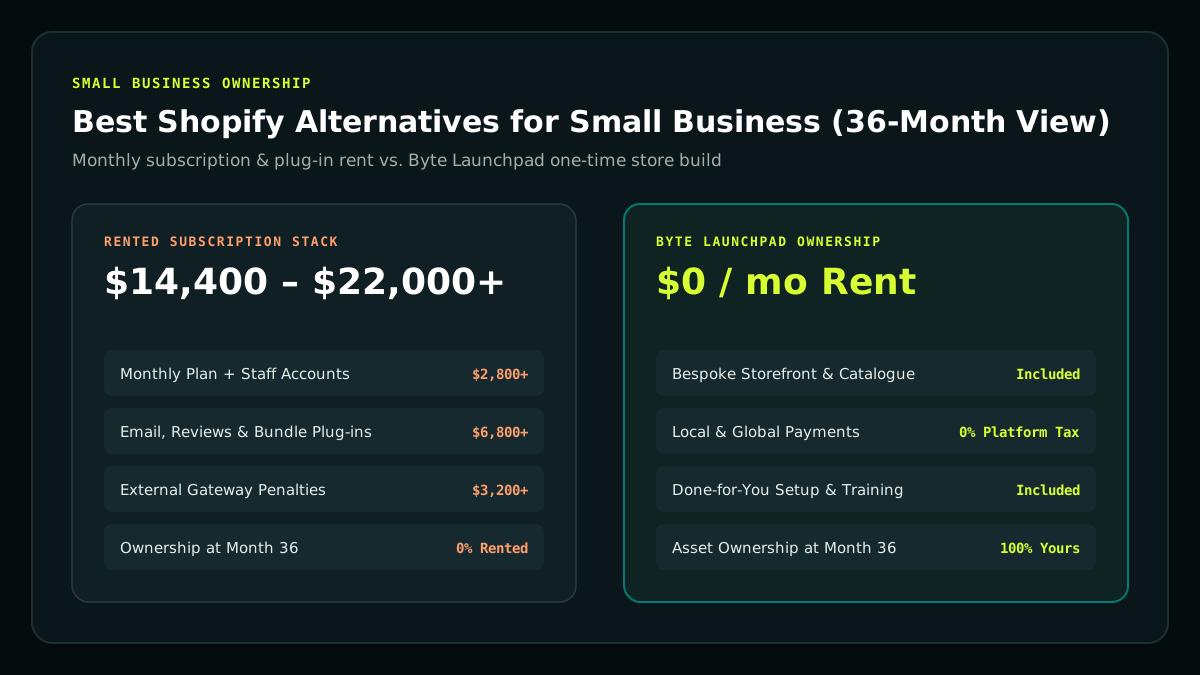
- The "App Tax" on Everyday Business Needs: Want to offer "buy three, save 15%" bundles? That is a paid monthly app. Want to collect trade orders from wholesale stockists on a password-protected page? Another paid monthly app. Want size charts, back-in-stock email alerts, or local courier rates? Three more monthly bills. Soon, a small business paying $39 for its base plan is paying $320 every month just to keep basic selling features switched on.
- Extra Surcharges on Your Own Revenue: If your business operates in a region or industry where you prefer your own payment provider (such as Paystack, Flutterwave, Authorize.net, or a negotiated bank merchant account) rather than the platform's internal processor, you get hit with an extra 0.5% to 2.0% platform penalty on every transaction. On $20,000 a month in sales, a 1.5% penalty quietly drains $3,600 a year from your bottom line for zero added value.
- Every Store Looks Like the Same Template: Customers in 2026 are sharp. When your website uses the exact same free template, font, and layout as fifty pop-up gadget stores they saw on social media that morning, it cheapens your brand authority and lowers the price customers are willing to pay.
- You Never Build Equity in the Storefront: After paying rent for five years, if you decide to pause or move, you cannot export your theme, your checkout layout, or your app setup. You were renovating a landlord's building the entire time.
If cutting recurring overhead is your primary goal, make sure you also review our full financial breakdown of the cheapest alternative to Shopify.
The 4 Commercial Rules for Choosing a Small Business Store Platform
Before we rank the seven platforms, here is the four-point checklist we advise every small business director to use when comparing options:
- Rule 1: Look at 36-Month Total Cost, Not Month-One Teaser Pricing. Calculate the base plan + 5 essential add-ons + payment processing fees + setup labour over three full years.
- Rule 2: Decide Early Whether You Want a DIY Tool or a Done-For-You Partner. If your time is worth $100+ an hour to your business, spending eighty hours learning a "self-service" website builder is an $8,000 hidden cost.
- Rule 3: Insist on Direct Payment & Fulfilment Freedom. Your platform should let you plug in the payment gateways, local couriers, and accounting tools your business already trusts without charging you a toll fee.
- Rule 4: Make Sure Google and AI Search Can Find Your Products. Paid ads are expensive. Your online store must have fast mobile loading and clean structured data built in so customers searching Google find your products organically.
At-a-Glance Comparison: The 7 Best Shopify Alternatives for Small Business
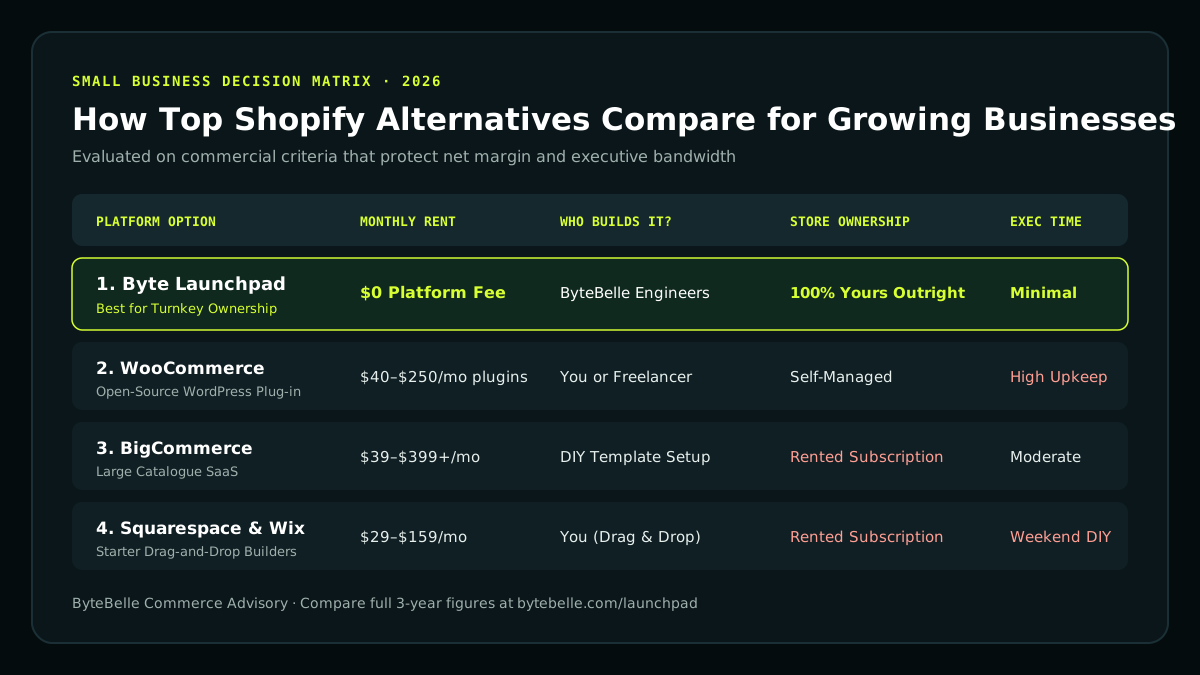
Here is how the seven leading options stack up side by side for a practical small-to-medium business:
| Platform / Service | Pricing Model | Who Builds the Store? | Extra Gateway Penalty? | Store Ownership | Best For |
|---|---|---|---|---|---|
| 1. Byte Launchpad | One-time build fee ($0/mo rent) | ByteBelle Engineers (Done-for-you) | 0% (None) | 100% Owned by You | Established small businesses wanting turnkey ownership & high margins |
| 2. BigCommerce | $39–$399+/mo (scales with sales) | DIY Template or Paid Agency | 0% on most gateways | Rented Subscription | Larger catalogues wanting built-in features under a monthly subscription |
| 3. WooCommerce | Free core + $50–$250/mo hosting & plugins | DIY or Freelance Developer | 0% (None) | 100% Owned (Self-maintained) | Businesses already running WordPress with someone technical on call |
| 4. Squarespace | $25–$72/mo | DIY Drag-and-Drop | 0% on Commerce tiers | Rented Subscription | Small visual brands with under 50 simple products |
| 5. Wix Ecommerce | $29–$159/mo | DIY Drag-and-Drop | 0% (Higher native rates) | Rented Subscription | Solo founders who want to design pages themselves by dragging boxes |
| 6. Shift4Shop | Free with Shift4 processing or $39+/mo | DIY Template Setup | Locked to Shift4 for $0 plan | Rented Subscription | US-based merchants comfortable switching to Shift4 card processing |
| 7. Ecwid by Lightspeed | $0–$105/mo | DIY Widget Embed | 0% (Tier limits apply) | Rented Widget | Adding a small shopping basket onto an existing brochure website |
Detailed Breakdown of the 7 Top Alternatives (Pros, Cons & Real Costs)
Let us examine each of the seven alternatives side by side, including where each option shines and where the fine print bites.
1. Byte Launchpad by ByteBelle: Best Overall for Turnkey Ownership & Profit Margin Protection
Most lists of the best Shopify alternatives for small business only compare one monthly subscription company against another monthly subscription company. Byte Launchpad changes the commercial equation entirely by combining custom store engineering with a one-time development model.
Instead of handing you a blank login and wishing you luck, our team at ByteBelle designs, builds, and configures your entire online store around your brand, your products, and your daily operations. Need retail and trade pricing on the same site? We build it in. Need instant WhatsApp order confirmations, local courier calculations, and multi-currency card checkout? We build it in. Need to launch even faster on a proven foundation? You can pick a ready-made commerce system from the ByteBelle Showroom and have our engineers customize it to your exact brand colours, domain, and catalogue.
- Commercial Advantage: Once we launch your store, you own the code and platform outright. You pay $0 in monthly platform rent to ByteBelle, and you never pay a percentage penalty on your sales.
- Who Should Choose It: Small business owners, retail directors, and growing brands who want a fast, custom-designed online store built by professionals, and who prefer a one-time capital investment over endless monthly software bills.
- Who Should Skip It: Hobbyists looking for a $0 weekend experiment with no initial budget.
2. BigCommerce: Best Subscription Option for Multi-Category Catalogues
If you are determined to stay on a monthly rented software platform but hate buying ten separate apps just to run your catalogue, BigCommerce is the closest direct competitor to Shopify.
- Where It Works Well: BigCommerce includes multi-currency pricing, detailed product options, customer group discounts, and Google-friendly URLs inside its standard monthly plans without forcing you to install third-party apps. It also does not charge an extra penalty if you use your own payment gateway.
- Where to Watch Out: BigCommerce enforces automatic revenue tiers. Once your store crosses $50,000 in annual online sales, your monthly bill jumps from $39 to $105/month; cross $180,000, and it jumps to $399/month. In short, the harder you work to grow your revenue, the higher your software rent climbs.
3. WooCommerce: Best Open-Source Option If You Have Technical Support
WooCommerce is a plug-in that turns a WordPress website into an online shop. Because it is open-source software, over three million websites use it worldwide.
- Where It Works Well: You own your customer and product database, and nobody can arbitrarily shut down your account or tax your transactions. If your company already publishes a large WordPress blog, WooCommerce slots right alongside it.
- Where to Watch Out: "Free open-source software" is only free if your time is worth zero. To make WooCommerce perform like a modern commercial store, you have to buy premium extensions for shipping, subscriptions, and fast checkout, with each one charging an annual renewal fee of $79 to $299. Worse, when WordPress updates on a Tuesday and one of your twenty plug-ins has not updated yet, your checkout button can quietly stop working until you pay a developer to repair it.
4. Squarespace Commerce: Best for Visual Boutiques With Small Catalogues
Squarespace started as a portfolio website builder for photographers and architects, and its visual polish remains its greatest strength.
- Where It Works Well: If you sell fifteen handmade leather bags, curated gift boxes, or limited-edition art prints, and you enjoy arranging photos yourself, Squarespace makes it easy to put together a clean, magazine-style storefront for $33 to $72 a month.
- Where to Watch Out: Its back-office inventory and order tools are basic. The moment your business needs barcode scanning, complex shipping weights, bulk price editing across 300 items, or automated warehouse handoffs, Squarespace starts feeling constricting.
5. Wix Ecommerce: Best for Solo Founders Who Like Drag-and-Drop Editing
Wix gives you a completely free-form canvas where you can drag text boxes, buttons, and product galleries anywhere on the screen using your mouse.
- Where It Works Well: For a solo business owner who genuinely enjoys tinkering with page layouts and wants built-in appointment booking alongside a small shop, Wix is approachable and packs a lot of features into its $29 to $159 monthly plans.
- Where to Watch Out: Because Wix lets users drag elements anywhere on the desktop screen, the mobile phone version often gets messy unless you manually rearrange every page for mobile. Furthermore, you cannot easily export a Wix site if you ever decide to move to a more serious commerce platform later.
6. Shift4Shop: Best Low-Fee Option for US Merchants Using Shift4 Payments
Formerly known as 3dcart, Shift4Shop was acquired by the payment processor Shift4 and offers an unusual proposition: their enterprise ecommerce plan is $0 per month if you process at least $500 a month through Shift4's credit card terminals.
- Where It Works Well: Includes a deep list of traditional back-office inventory, promotional, and wholesale tools without a monthly subscription fee, provided you are a US merchant approved for Shift4 payment processing.
- Where to Watch Out: Its visual templates and admin dashboard feel noticeably dated compared to modern storefronts, and international businesses outside the US cannot take advantage of the free processing bundle.
7. Ecwid (by Lightspeed): Best for Bolting a Small Shop Onto an Existing Website
If your company already has a service website that you love and you simply want to add a "Buy Now" catalogue for ten or twenty products without rebuilding your whole site, Ecwid is built for that job.
- Where It Works Well: Drops into almost any existing website in an afternoon and syncs with Lightspeed retail point-of-sale systems.
- Where to Watch Out: Because it runs as an embedded widget rather than a dedicated commerce engine, its search engine visibility (SEO) and checkout customisation are no match for a purpose-built storefront.
Why Done-For-You Store Ownership Beats Weekend DIY Templates
Let us pause and look at the pattern in the table above. Options 2 through 7 all assume one thing: that you, the business owner, want to be the web designer, the systems integrator, and the ongoing software tenant.
When we built ByteBelle's Launchpad service, we built it for executives who recognise that their highest-value job is sourcing great products, serving customers, and growing revenue, rather than troubleshooting plug-ins. Look at what happens when we build a custom commerce engine for a growing brand like Asoebi Lounge: by replacing slow, manual order-taking and generic templates with a fast, custom-engineered mobile storefront, their online orders grew by +300% within months.
Whether you are running a boutique retail operation, a high-margin dropshipping and supplier model (see our guide on the best Shopify alternatives for dropshipping), or evaluating the best ecommerce platform for multi-location growth, owning your store outright gives your business three unfair advantages:
- Zero Monthly Software Bleed: Your fixed overhead stays low in quiet months, and 100% of your upside stays in your bank account during peak seasons.
- Faster Mobile Buying: Because your store is not weighed down by fifteen third-party tracking and pop-up scripts, pages load almost instantly on your customer's phone, which directly lifts completed checkouts.
- Tailored Around Your Team: If your warehouse needs orders grouped by delivery zone at 7:00 AM every morning, or your sales reps need a quick link to generate custom trade invoices, we build that exact workflow into your dashboard.
How to Switch Your Small Business Store in 14 Days Without Downtime
You do not have to wait until your annual software renewal to stop overpaying. Moving a small business store to Byte Launchpad is structured so your daily trading never skips a beat:
- Share Your Brief (Day 1): Complete our straightforward Launchpad Store Setup Brief telling us what you sell, how many products you carry, and what you dislike about your current setup.
- Fixed Scope & Commercial Agreement (Days 2–3): We review your catalogue and walk you through a clear, transparent proposal covering your one-time development fee, timeline, and full ownership terms.
- Design, Build & Catalogue Import (Days 4–12): Our engineers build your new storefront, migrate your products and photos, connect your payment accounts, and configure your Google search structure.
- Staff Walkthrough & Go-Live (Days 13–14): We walk your team through the dashboard in a 30-minute live session and point your domain to your new store with zero lost orders.
Ready to stop renting templates and own a store built around your business? Plan your store on Byte Launchpad today or speak with our commercial team.
Independent benchmarks on open-source store ownership vs. hosted SaaS plans can also be cross-checked directly against WooCommerce and Paystack's commerce documentation.
Best Shopify alternatives for small business: acceptance checks
When comparing the best Shopify alternatives for small business, let the person who handles daily orders run the demonstration. Ask them to correct stock, refund an item and find a customer record without developer help; these tasks reveal practical differences that a feature checklist misses.
Executive FAQ: Common Questions Answered
What is the #1 best Shopify alternative for an established small business?+
For an established small business that values both profit margins and executive time, Byte Launchpad by ByteBelle is the strongest alternative. Instead of renting a DIY template and paying monthly for a dozen plug-ins, our engineering team builds a custom storefront around your business for a one-time development fee, and you own the store outright.
Why do small businesses outgrow Shopify so quickly?+
Small businesses usually outgrow Shopify's pricing structure long before they outgrow its servers. The moment you need more than a basic template, such as trade pricing, bundle offers, custom delivery zones, or additional staff logins, you are forced to stack paid monthly apps or upgrade to expensive plans that eat into your margins.
Is WooCommerce a good Shopify alternative for a non-technical business owner?+
WooCommerce gives you good control over your data, but it is rarely ideal for a busy, non-technical business owner unless you have a dedicated web person on retainer. Because WooCommerce relies on WordPress and dozens of separate third-party extensions, routine software updates can occasionally break your checkout page until someone fixes it.
How much time does my team need to spend to launch on Byte Launchpad?+
Very little. You spend roughly 45 minutes with our commercial team walking through your products, brand preferences, payment accounts, and shipping rules. Our designers and engineers handle the entire build, product setup, and testing, then hand over a finished store with a clear walkthrough for your staff.
Can a Byte Launchpad store handle both local currencies and international card payments?+
Yes. Unlike rented platforms that penalise you for using outside payment providers, Byte Launchpad connects directly to the payment processors that make the most sense for your customers, including Stripe, Paystack, local bank transfers, and multi-currency checkouts, all at standard bank processing rates.