Standard consumer apps can recover gracefully from an occasional UI glitch or delayed webhook. Financial products cannot. Whether you are building a digital savings cooperative, an SME treasury tool, a cross-border remittance wallet, a lending engine, or a multi-chain asset platform, fintech app development in Nigeria demands strict transactional, cryptographic, and operational discipline from line one of code.
Across Lagos and Pan-African fintech hubs, most expensive post-launch crises stem not from interface styling, but from shortcut database schemas that fail under real bank-rail latency and concurrent user requests.
Why Fintech Engineering Follows Different Rules
Nigerian financial products operate across dynamic mobile networks, instant bank-transfer rails, and tiered regulatory identity checks. When a transfer modal stalls for 30 seconds during peak salary week, users instinctively hit retry; when an external banking partner reverses a failed NIP credit hours later, your backend must catch the reversal automatically without corrupting customer balances.
Designing fintech software means assuming network drops, duplicate callbacks, and partial provider failures will happen daily—and guaranteeing mathematical ledger accuracy anyway.
Core Architecture: Double-Entry Ledgers & Idempotency
Three database and API patterns separate production financial systems from fragile prototypes:
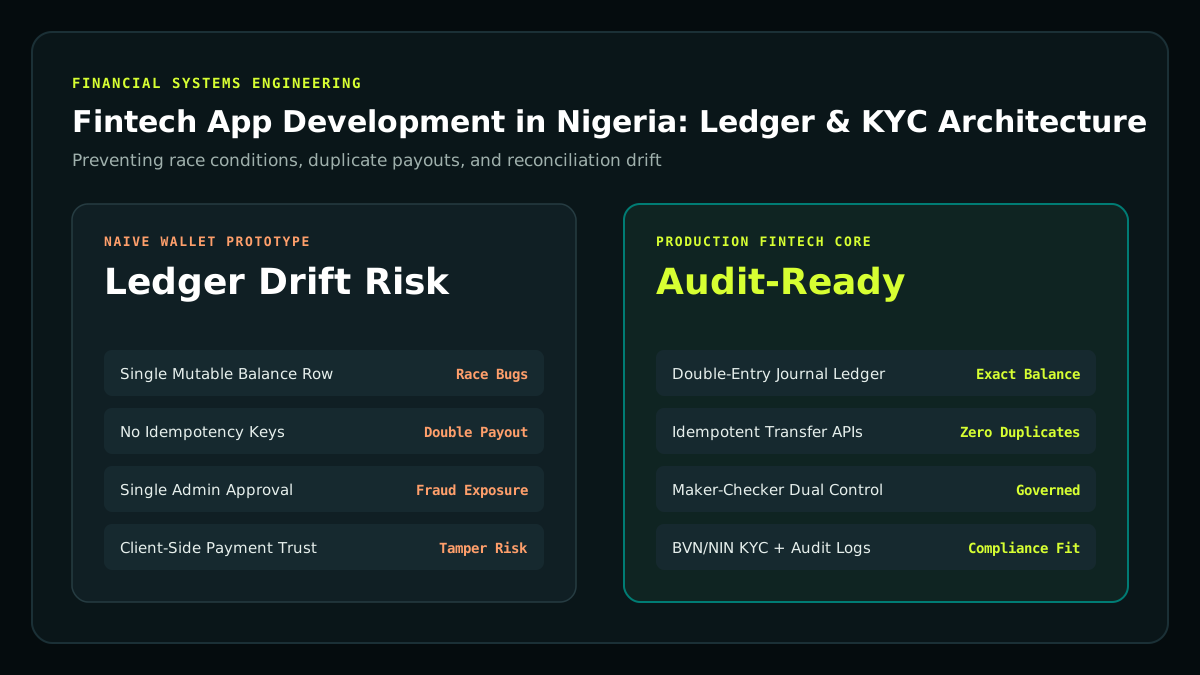
- Append-Only Double-Entry Ledgers: Never store a customer's money purely as a single mutable
balanceinteger that gets overwritten withbalance = balance - amount. Instead, maintain an immutable journal of balanced debit and credit entries in PostgreSQL/Supabase. Every Naira or Dollar in a user wallet equals the cryptographic sum of audited ledger entries.
- Idempotency Keys on Every Financial Mutation: Require clients and webhook processors to pass unique idempotency keys on every transfer, payout, or wallet credit. If an unstable 3G signal submits the same payout request three times, the database processes it exactly once and returns the cached result cleanly.
- Database Row-Level Locking & Atomic Transactions: Wrap balance checks, debit entries, fee allocations, and payout-queue inserts inside serializable database transactions so concurrent requests can never overdraw an account via a millisecond race condition.
BVN/NIN Onboarding, Virtual Accounts & Maker-Checker Controls
| Fintech Layer | Production Requirement | Practical Nigerian Implementation |
| :--- | :--- | :--- |
| Tiered KYC Onboarding | Verify identity smoothly without killing signup conversion | BVN/NIN API lookup + selfie liveness mapped to Tier 1/2/3 limits |
| Wallet Funding Rails | Instant bank transfer funding from any Nigerian bank | Dedicated virtual accounts via Paystack, Monnify, or banking APIs |
| Payout Safety | Eliminate transfers to mistyped account numbers | Mandatory bank-account name-enquiry confirmation prior to transfer execution |
| Maker-Checker Governance | Prevent rogue internal payouts or manual balance edits | Dual-staff approval workflow required for manual credits and high-value disbursements |
| Immutable Audit Trail | Full forensic traceability for compliance & disputes | Append-only logs recording actor ID, timestamp, IP, device, and state diff |
Reconciling Bank Transfers, Webhooks & Settlement Exceptions
Even reliable bank partners occasionally drop webhook notifications or settle batch reversals asynchronously. Every serious fintech backend runs an automated Reconciliation Worker:
- Pending-Transaction Polling: Any payout or inbound transfer stuck in
PENDINGafter three minutes is queried automatically against the provider's status API.
- Daily Ledger-to-Bank Settlement Check: An automated end-of-day job compares internal customer wallet totals plus fee revenue against actual settlement balances held at partner banks—flagging even a ₦1 variance immediately in an exception queue.
- Clean Pending UI States: Users seeing clear real-time status tracking ('Processing with recipient bank') contact customer support far less often than users left staring at ambiguous errors.
Compliance Boundaries: Engineering Controls vs. CBN Licensing
Be realistic about legal vs. technical scope. No software agency can grant or guarantee regulatory approval from the Central Bank of Nigeria (CBN) or SEC, nor bypass Nigeria Data Protection Commission (NDPC) obligations. Licensing, PSP/MMO/MFB structuring, and partner-bank sponsor agreements remain dedicated legal and compliance workstreams. Your engineering partner's job is to collaborate closely with your legal and security advisors to implement the exact audit logs, KYC limit gates, encryption, and maker-checker controls your licence requires.
Scoping Your Fintech MVP Safely in 2026
Look at ByteBelle's work on FLYPA, where multi-chain quoting and execution achieved 0.8-second latency behind crisp operational clarity. When planning your own financial platform, lock down your ledger model, KYC tier rules, and reconciliation loop in Phase 1 before layering secondary features.
Explore our Secure Fintech App Developers Lagos page, review our Mobile App Development service and Mobile App Cost Guide, or book a technical discovery call with our engineers.
Designing Trustworthy Mobile & Web UX for Nigerian Financial Users
Technical security behind the scenes only retains customers if the interface feels calm, transparent, and trustworthy in their hands. Nigerian fintech users have grown sharp at spotting sloppy apps:
- Explicit Fee & Exchange-Rate Previews: Show transfer fees, stamp duty rules (where applicable), or FX conversion spreads clearly before the user enters their PIN or biometric confirmation. Hidden deductions destroy retention immediately.
- Deterministic Receipt & Reference Sharing: After every transfer, bill payment, or loan disbursement, generate a crisp, downloadable or WhatsApp-shareable receipt showing timestamp, session/reference ID, beneficiary bank, and verified status.
- Biometric & PIN Step-Up Authentication: Require Face ID, fingerprint, or a 4–6 digit transaction PIN for outgoing transfers and bank-account changes—distinct from login passwords—paired with automatic session lock after inactivity.
- Graceful Offline & Slow-Network Handling: Show clear cached transaction history when cellular signal drops in elevators or traffic, and disable submit buttons with loading indicators during requests so users never accidentally trigger duplicate submissions.
Phased Delivery Roadmap: From Discovery to Production Launch
| Delivery Phase | Typical Duration | Key Engineering & Security Deliverables |
| :--- | :--- | :--- |
| Phase 1 · Architecture & Compliance Alignment | Weeks 1–3 | Double-entry DB schema, KYC tier flows, provider selection, security threat model |
| Phase 2 · Core Ledger, Auth & Onboarding | Weeks 4–8 | Mobile/web UI, OTP & biometrics, BVN/NIN KYC webhooks, virtual account funding |
| Phase 3 · Payouts, Admin & Reconciliation | Weeks 9–14 | Idempotent payouts, maker-checker console, automated daily bank reconciliation |
| Phase 4 · Penetration Testing & Controlled Beta | Weeks 15–18+ | Vulnerability remediation, load testing, internal staff & closed-beta transaction audit |
Security Testing & Penetration Audits Before Public Scale
Never launch a financial product to the public without independent security verification. Before opening onboarding widely, enforce strict automated integration tests around balance concurrency (simulating 20 simultaneous withdrawal requests against one account), audit API endpoints for broken object-level authorization (IDOR), verify encrypted secrets management, and run third-party Vulnerability Assessment and Penetration Testing (VAPT) across mobile binaries and cloud APIs.
Partnering with an engineering team that treats ledger integrity, auditability, and UX clarity as one unified system prevents painful rewrites as user transaction volume grows. Explore ByteBelle's Secure Fintech Engineering, inspect our Advanced & Enterprise Packages, or schedule a technical scoping session.
Designing Resilient Fraud Rules, Rate Limits & Velocity Checks
Beyond ledger accuracy, production fintech products need automated velocity and anomaly rules sitting in front of every transfer, loan application, and card-funding endpoint:
- Per-Account & Per-Device Velocity Caps: Throttle rapid-fire failed PIN attempts, repeated BVN verification retries, and unusual midnight withdrawal bursts automatically—locking suspicious sessions for manual compliance review while letting normal daytime activity flow smoothly.
- Webhook Replay & IP Allowlisting: Configure gateway webhook handlers to verify both HMAC cryptographic signatures and documented provider source IPs, rejecting spoofed external POST payloads immediately at the edge.
- Tiered Daily & Single-Transaction Limits: Enforce CBN-aligned KYC tier caps inside server database checks—never solely in mobile UI validation—so unverified accounts cannot bypass limits via direct API calls.
- Alerting on Reconciliation & Float Thresholds: Notify finance directors automatically when settlement float accounts drop below pre-agreed liquidity thresholds or when gateway error rates spike above 2%, ensuring payout continuity during busy weekend trading windows.
Together, those engineering controls protect customer deposits, satisfy partner-bank diligence reviews, and keep operations teams confident as transaction volume scales across Nigeria and diaspora corridors.
Multi-Currency, Remittance & Card Issuing Readiness
As Nigerian fintech products mature from single-currency Naira wallets into cross-border remittance apps, USD virtual-card programmes, or diaspora savings clubs, database architecture must support multi-currency ledgers cleanly from day one. Store monetary amounts strictly in integer minor units (kobo, cents, pence) alongside explicit ISO currency codes and locked FX quote snapshots at transaction execution—never floating-point decimals, which introduce rounding discrepancies during high-volume settlement batches.
Pairing clean minor-unit ledger accounting with explicit FX rate audit tables keeps cross-border customer balances reconcilable to the exact unit across every banking and card-issuing partner.
Building Customer Support Tooling Into Day-One Fintech Operations
Customer trust in Nigerian financial apps hinges on how quickly support teams resolve stuck transfers or KYC verification queries. Build an internal read-only transaction inspector from day one showing exact gateway timestamps, webhook payloads, ledger journal entries, and KYC document rejection reasons so support agents resolve enquiries in sixty seconds without escalating routine lookups to senior engineers.
Before releasing any production fintech build, run automated regression tests simulating network timeouts, duplicate webhooks, and partial settlement reversals across every ledger account type to confirm exact mathematical consistency.
Fintech app development in Nigeria: acceptance checks
Scope fintech app development in Nigeria around explicit transaction states, reconciliation procedures and access roles. The delivery plan should explain how the team demonstrates correctness when a provider response is delayed or duplicated.
Before commissioning fintech app development in Nigeria, agree who reviews regulatory questions and who operates transaction exceptions. Software acceptance should include those handoffs, without treating engineering delivery as permission to offer a regulated service.
Executive FAQ: Common Questions Answered
Can a software agency obtain our CBN fintech licence for us?+
No. Regulatory licensing (such as CBN PSP/MMO/MFB approvals or partnership banking agreements) is a separate legal and compliance process. ByteBelle works closely alongside your legal, security, and compliance advisors to implement the technical controls, audit logs, and KYC workflows required.
What happens if two transfer requests hit the server at the exact same millisecond?+
Without database-level row locking and idempotency keys, a double-tap on slow mobile internet can trigger a double debit or double credit. Proper fintech ledgers use atomic database transactions and unique client request keys to guarantee exactly-once settlement.
How long does it take to build a fintech v1 product?+
Most production fintech MVPs require 12 to 24+ weeks across discovery, UI/UX prototyping, ledger and KYC API integration, security testing, and phased launch.