Many companies treat website launch day like the finish line. Six months later, an enquiry form silently stops delivering leads because an email relay password rotated, an SSL renewal fails on a Friday evening, or an unpatched third-party plugin exposes customer pages to spam redirects.
Understanding realistic website maintenance cost in Nigeria helps operations, marketing, and finance leaders budget calmly for uptime, cybersecurity, backups, and continuous conversion updates long before an outage hits revenue.
Why 'Set and Forget' Websites Quietly Lose Leads
Web applications operate inside a constantly shifting environment. Chrome and Safari ship security and rendering updates every few weeks; payment gateways deprecate legacy TLS ciphers and webhook headers; npm and PHP packages publish critical vulnerability patches; and automated scanners probe /wp-admin, .env files, and exposed endpoints around the clock.
Without scheduled monitoring and maintenance, business owners usually discover an issue only after a prospect calls on the phone asking why the website displays a browser security warning or fails at checkout.
2026 Website Maintenance Cost Ranges in Nigeria (NGN & USD)
Maintenance pricing scales with operational risk—a five-page consulting site needs far less daily oversight than an active multi-currency storefront or regulated fintech portal:
| Support Tier | Typical Nigerian Monthly Budget | Backup & Monitoring Cadence | What Should Be Included |
| :--- | :--- | :--- | :--- |
| Essential Care (Brochure / Profile Sites) | ₦45,000 – ₦120,000 / mo ($45–$120) | Weekly off-site backups + uptime pings | SSL/DNS checks, security updates, broken-link checks, minor text/image edits |
| Growth & Ecommerce Care | ₦150,000 – ₦350,000 / mo ($150–$350) | Daily DB backups + checkout alerts | Payment webhook monitoring, Core Web Vitals checks, conversion tweaks, priority fixes |
| Dedicated Engineering SLA (Web Apps & SaaS) | ₦400,000 – ₦1,200,000+ / mo ($400–$1,200+) | Point-in-time DB recovery + error tracking | Scheduled feature sprints, staging QA, cloud cost optimisation, strict response SLA |
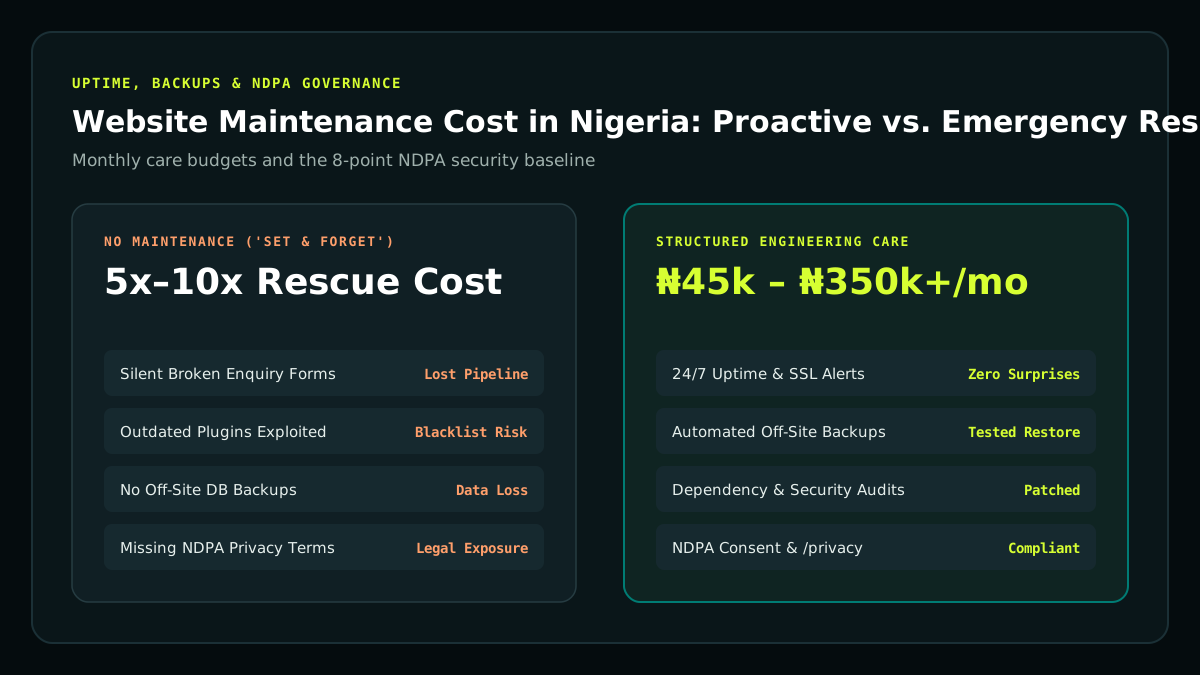
Compare those predictable monthly retainers against the cost of an emergency breach cleanup, malware removal, or rebuilding a corrupted database from scratch—which routinely runs 5x to 10x higher alongside days of lost sales and damaged brand trust.
The 8-Point Security & NDPA Compliance Checklist
Every commercial website serving customers in Nigeria or processing international client enquiries should enforce these eight baseline controls:
- Enforced HTTPS, HSTS & TLS Monitoring: Zero mixed-content warnings across assets, forms, and checkout scripts, with automated alerts 30 days before domain or SSL expiry.
- Dedicated Privacy Policy & Terms Pages: Accessible in the global footer (such as ByteBelle's Privacy Policy and Terms of Service) detailing data collection, retention windows, and user rights aligned with the Nigeria Data Protection Commission (NDPC).
- Form Consent, Validation & Rate Limiting: Explicit privacy consent checkboxes paired with server-side schema validation, honeypot traps, and IP rate limiting to stop bot spam floods.
- Role-Based Admin Access & Multi-Factor Authentication: Never share one generic
adminlogin across staff and external contractors; revoke access immediately when team members rotate.
- Automated Off-Site Backups With Restore Drills: Backups stored on the exact same server disk fail during hardware or ransomware incidents. Store encrypted backups off-site and run periodic restore tests.
- Dependency & Vulnerability Patching: Run scheduled
npm auditor CMS extension reviews to patch known CVEs before automated bots exploit them.
- Cryptographic Webhook Verification: Validate HMAC signatures on Paystack, Flutterwave, and Stripe callbacks plus server-side transaction verification.
- Real-Time Error & Uptime Alerting: Route HTTP 500 errors, form-delivery failures, and latency spikes straight to Slack or engineering email within minutes.
WordPress vs. Custom React Sites: Maintenance Workload
Architecture directly dictates how expensive maintenance becomes. Heavy WordPress installations loaded with 25 third-party plugins require constant firefighting because updating Plugin A frequently breaks Plugin B or the page builder layout. By contrast, custom pre-rendered React and TypeScript platforms hosted behind Cloudflare or modern edge CDNs eliminate public PHP plugin surfaces completely—reducing routine care to clean dependency updates, content refreshes, and uptime telemetry. Dive deeper in our Custom Website vs. WordPress Comparison.
What Should Actually Be Inside a Support Retainer SLA
Avoid vague maintenance contracts that charge monthly fees without defining deliverables. Insist on written clarity covering:
- Response & Resolution Targets: Distinct response windows for Critical Outages (site down or checkout broken) vs. Routine Content Updates (swapping team bios or pricing copy).
- Included Monthly Engineering Hours: Know exactly how many small feature or content hours roll into the plan and how unused/overflow hours are handled.
- Monthly Health Report: A crisp monthly summary confirming uptime percentage, backup status, security patches applied, and Core Web Vitals health.
When to Maintain vs. When to Modernise Your Stack
Maintenance makes sense when the underlying platform is sound and supports your business goals. If your team spends more every quarter rescuing crashed templates, apologising to mobile shoppers for six-second checkout loads, and patching legacy code than building new value, stop pouring budget into repairs. Read our Cloud & Performance Engineering offer, inspect transparent care options across our Packages hub, or run a quick baseline check in our free SEO & GEO Checker.
Real Incident Scenarios: What Happens When Maintenance Is Ignored
Understanding website maintenance cost in Nigeria becomes concrete the moment you examine the three outages Nigerian SMEs call engineering teams to rescue most often:
- The Silent Lead-Form Blackout: A B2B consultancy updates its Gmail or Microsoft 365 password, breaking the SMTP relay inside its website contact form. Paid Instagram and Google Ads keep spending ₦400,000/month while every incoming enquiry fails silently with an unlogged server error for six weeks.
- The Pirated-Theme Malware Redirect: A low-cost WordPress build uses an unlicensed premium theme that stops receiving security patches. Automated crawlers inject hidden pharmaceutical spam pages or mobile ad redirects—leading Google Chrome to display a red 'Deceptive site ahead' warning to every customer.
- The Expired Domain or SSL Panic: Because the domain was registered under a former freelancer's personal inbox, renewal reminders go unread. On Monday morning, the website vanishes or displays a certificate error across WhatsApp links and bank payment webhooks.
Every single one of those incidents costs vastly more in lost trust, emergency rescue retainers, and wasted ad spend than a disciplined monthly maintenance plan.
Custom Care Checklists for E-Commerce & High-Traffic Portals
If your website processes online payments or handles user logins daily, basic uptime pings are not enough. Your engineering care routine should also verify:
- End-to-End Synthetic Checkout Checks: Confirm weekly that cart additions, shipping zone calculations, Paystack/Flutterwave/Stripe modal initialization, and order confirmation emails complete without console or API errors.
- Database Index & Storage Health: Trim stale session tables, monitor query latency spikes, and confirm database storage utilization never approaches tier ceilings during seasonal sales peaks.
- 404 & Redirect Hygiene: Review server 404 logs monthly so broken external backlinks or changed product slugs get clean 301 redirects instead of losing organic search visitors.
- Third-Party API Deprecation Watch: Payment gateways, Meta pixels, WhatsApp Business APIs, and analytics SDKs deprecate old versions annually; scheduled engineering reviews migrate endpoints smoothly ahead of cutoff deadlines.
- Accessibility & Mobile Viewport Regression Checks: After adding new sections, landing banners, or team photos, verify zero horizontal overflow on 360px/390px smartphones and confirm image compression keeps page weights lean.
How ByteBelle Structures Post-Launch Handover & Support
We never trap clients into mandatory maintenance contracts just to hold their own website hostage. Every ByteBelle build hands over clean Git source code, documented environment setup, and team handover training. Clients who want continuous peace of mind can add structured monthly hosting, proactive care, priority engineering SLA, or managed technical SEO retainers transparently—scaled strictly to what their platform actually requires.
Review our clear Packages & Care Options, audit your current site's technical health using our AI Search & SEO Checker, or contact our engineering team to review an existing platform.
Evaluating Website Redesign vs. Targeted Maintenance
Sometimes maintenance reveals deeper structural problems that quick patches cannot fix—for instance, a six-year-old site built on discontinued PHP plugins, non-responsive mobile tables, or rigid checkout templates that block modern Nigerian payment methods. If annual repair and patch bills begin exceeding 30%–40% of a clean modern rebuild cost, migrating onto a lean React/TypeScript foundation pays back rapidly through lower ongoing support overhead, stronger Google Core Web Vitals, and higher mobile conversion.
Equally, keep an accurate inventory of every third-party integration connected to your website—domain registrar, DNS host, SSL issuer, transactional SMTP/API provider, CRM webhooks, payment gateways, and analytics accounts—stored in a company-owned password vault rather than scattered across individual employee laptops. When personnel or agency partners change, clean documentation prevents emergency outages and keeps maintenance costs predictable year round.
Key Questions to Ask Before Signing Any Maintenance Agreement
Before committing to an annual or monthly website care contract, confirm four practical terms in writing: first, whether unused minor update hours roll over or expire monthly; second, what the guaranteed response SLA is for weekend checkout or DNS outages; third, where off-site encrypted backups are stored and how long retention lasts; and fourth, whether security updates cover both application dependencies and server/edge WAF configuration. Clear expectations turn maintenance from an opaque recurring invoice into reliable operational insurance.
Website maintenance cost in Nigeria: acceptance checks
Compare website maintenance cost in Nigeria using a written list of supported systems, response windows and recovery responsibilities. Clarify whether the agreement includes implementing fixes or only reporting that a check failed.
Executive FAQ: Common Questions Answered
Do custom-built websites still need ongoing maintenance?+
Custom React/TypeScript websites require far less emergency patching than plugin-heavy WordPress sites, but still benefit from uptime monitoring, dependency/security updates, SSL and DNS checks, analytics verification, and small conversion or content updates.
What does NDPA compliance mean for a business website in Nigeria?+
Under the Nigeria Data Protection Act (NDPA), websites collecting personal data through enquiry, checkout, or onboarding forms should publish an accessible Privacy Policy, capture clear user consent, enforce HTTPS encryption, restrict admin access, and define data retention windows.
How often should website and database backups run?+
Brochure sites should have automated weekly backups stored off-server; ecommerce stores, booking engines, and SaaS portals require automated daily (or point-in-time) database backups with periodic restore drills.