Most ecommerce pricing guides written abroad assume your business earns in US dollars, ships via uniform postal APIs, and relies solely on credit cards. Nigerian retail and wholesale operators live in a completely different commercial reality: customers discover products on Instagram and Google, ask quick questions on WhatsApp, pay heavily via instant bank transfers, and expect delivery across Lagos, Abuja, Port Harcourt, and diaspora corridors in the UK or US.
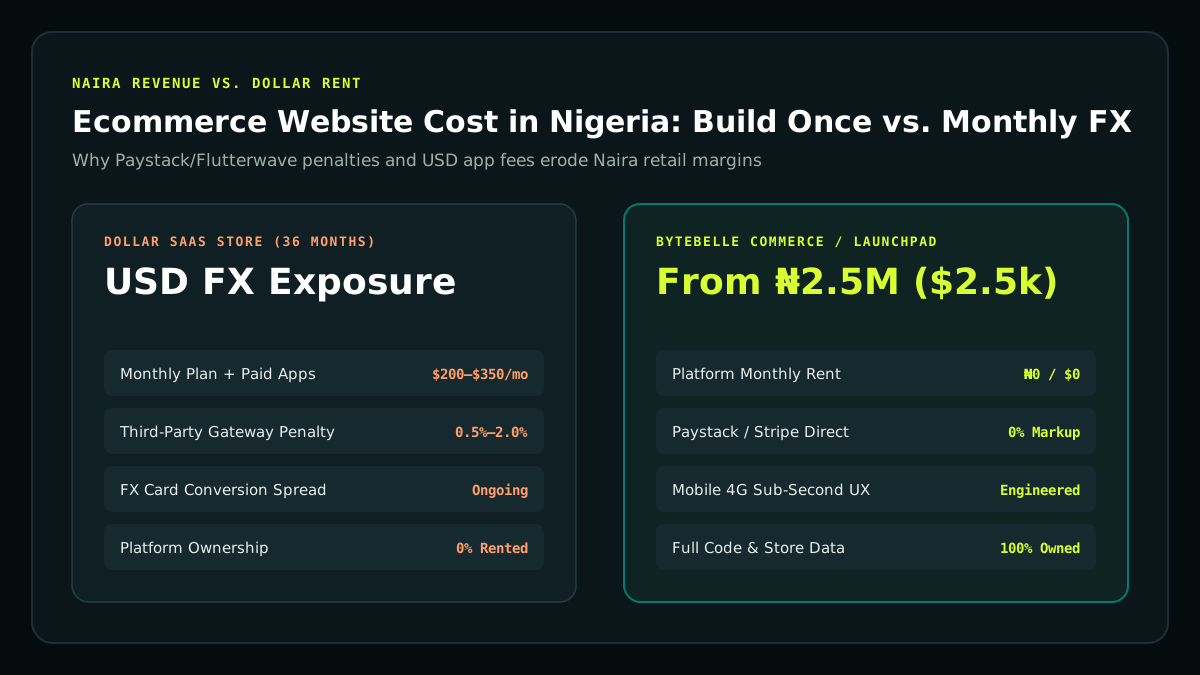
Meanwhile, if your online store runs on an international SaaS builder, every monthly subscription invoice, paid theme licence, and third-party app fee is billed in USD. Evaluating ecommerce website cost in Nigeria properly requires comparing both your launch build fee and your 36-month currency and transaction exposure.
The Nigerian FX Problem With Monthly Dollar Store Builders
When a Lagos fashion house, beauty brand, or Abuja electronics distributor launches on a monthly dollar builder like Shopify, the $39 introductory plan looks harmless in week one. Within three months, everyday operational needs force upgrades and paid apps: product bundles, photo reviews, wholesale tiers, automated WhatsApp/email recovery, search filters, and multi-currency conversion easily add $150 to $350 every single month.
Worse for Nigerian operators, because native Shopify Payments is not available to Nigerian-domiciled businesses, connecting local gateways like Paystack or Flutterwave triggers an extra 0.5% to 2.0% third-party transaction surcharge on top of your processor's normal rate. Over three years, that recurring USD outflow drains working capital that belongs in inventory and customer acquisition—which is why smart brands move to one-time ownership alternatives and Byte Launchpad.
2026 Ecommerce Website Cost Tiers in Nigeria
| Store Model | Upfront Investment (NGN / USD) | Ongoing Platform Rent | Typical Capabilities & Trade-Offs |
|---|---|---|---|
| Social Link / Starter Checkout | ₦0 – ₦250,000 | Low / Per-transaction | Basic product links; weak Google SEO, minimal brand trust, manual stock updates |
| Template WordPress / WooCommerce | ₦400,000 – ₦1,200,000 | Paid plugin & hosting renewals | Standard catalogue and local gateway plugin; slows down on shared hosting as traffic grows |
| ByteBelle Commerce / Launchpad Store | From ₦2,500,000 ($2,500) | $0 platform rent | Custom mobile-first UI, Paystack/Flutterwave/Stripe, stock sync, sub-second speed, SEO schema |
| Multi-Vendor Marketplace / Subscription Engine | From ₦6,000,000 ($6,000) | $0 platform rent | Vendor portals, escrow/split payouts, customer wallets, ERP & logistics APIs |
For a deeper feature-by-feature comparison of platform mechanics, see our breakdown of WooCommerce vs. Shopify vs. Custom Stores in Nigeria.
5 Technical Decisions That Drive an Online Store Budget
When scoping an online store proposal, five architectural choices move engineering hours—and ultimately price—more than anything else:
- Payment & Multi-Currency Orchestration: Integrating Paystack or Flutterwave for Naira cards and virtual-account bank transfers is baseline. Adding automatic currency switching (NGN, USD, and GBP) paired with Stripe for international diaspora buyers requires clean checkout state routing and FX price rules.
- Live Multi-Branch Inventory Sync: A single stockroom needs simple SKU decrementing. Syncing live inventory across Lekki, Ikeja, and Abuja physical stores—plus reconciling walk-in POS sales—requires atomic database stock locking so two shoppers never purchase the last unit during a promo drop.
- Delivery Zoning & Courier APIs: Flat shipping zones (e.g., Lagos Island, Lagos Mainland, Interstate) are quick to configure. Real-time courier rate quotes and automated waybill dispatch with logistics partners require custom webhook handlers and tracking dashboards.
- Catalogue Size, Variants & Filtering: Selling 25 signature skincare products is very different from merchandising 3,000 automotive parts or fashion textiles with colourway swatches, size matrices, and wholesale minimum-order rules.
- Zero-Downtime Migration & SEO Redirects: If you already run a store on Instagram, WooCommerce, or Shopify, importing historical orders, optimising heavy product photos to WebP, and mapping every existing URL via 301 redirects preserves your Google search equity.
Case Study Benchmark: Replacing WhatsApp DM Friction
Manual DM ordering caps growth precisely when demand spikes. Consider ByteBelle's work on Asoebi Lounge (Darlings Fabrics): previously slowed down by manual WhatsApp coordination during peak wedding seasons, migrating to a custom React and Supabase commerce engine delivered sub-1.4-second mobile page loads, high-resolution fabric swatch viewing, automated payment verification, +300% online orders, and 65% lower cart abandonment.
Faster mobile pages and friction-free bank transfer verification pay back the engineering investment directly through higher conversion on the exact same ad spend.
Payment Processing Fees & Margin Protection
Remember that platform build cost and payment processing fees are separate budgets. In Nigeria, local gateway fees sit around roughly 1.5% + ₦100 per local transaction (typically capped at ₦2,000 on local cards/transfers) and ~3.8%–4.5% on international cards, depending on provider tier and settlement currency. Always verify current merchant pricing directly with Paystack or Flutterwave, and eliminate unnecessary 0.5%–2% SaaS platform markups by owning your own checkout stack.
Choosing Between Launchpad, Commerce, and Custom Marketplaces
- Choose Byte Launchpad or a Showroom Kit if you want proven retail conversion speed, done-for-you catalogue setup, and zero monthly platform fees.
- Choose the ByteBelle Commerce Package (starting from ₦2,500,000 / $2,500) if your brand needs bespoke merchandising, custom bundle or wholesale rules, and multi-gateway orchestration.
- Configure add-ons transparently inside Build Your Project—including Loyalty & Referral Rewards, Customer Store Wallets, Subscription Billing, and Advanced Shipping Integrations—and receive a clear milestone proposal in NGN or USD.
Nigerian Ecommerce Logistics, Fulfilment & Returns Costs
Software build cost is only part of running a profitable online store. Operators in Lagos, Abuja, and Port Harcourt also have to design checkout around delivery realities:
- Intra-City Dispatch vs. Interstate Waybills: Same-day Lagos rider rates vary sharply between Island corridors (Ikoyi, VI, Lekki Phase 1, Ajah) and Mainland zones (Ikeja, Yaba, Surulere, Festac). Building clear zone tables into checkout prevents you from subsidising shipping out of product margin.
- Pay-on-Delivery Risk Management: High-return rates hurt cash flow. Custom checkout rules let you restrict Pay-on-Delivery to verified Lagos postcodes or require a small commitment deposit while encouraging instant bank transfers or card payments nationwide.
- WhatsApp & SMS Order Confirmation: Nigerian buyers trust instant confirmation. Triggering automated order receipts with tracking links immediately after Paystack webhook verification slashes inbound 'Did you see my alert?' messages.
Real-World 36-Month Store Budget: Rented Builder vs. Byte Launchpad
| Cost Line (36 Months) | Monthly Dollar SaaS Stack ($105/mo + $180 Apps) | Custom ByteBelle Commerce / Launchpad Store |
| :--- | :--- | :--- |
| Upfront Store Design & Engineering | $0 – $3,000 (DIY time or freelance setup) | ₦2,500,000 ($2,500) fixed one-time build |
| Monthly Platform Subscription (36 Months) | $3,780 USD | ₦0 / $0 |
| Essential Apps (Reviews, Wholesale, Loyalty, WhatsApp) | $6,480 USD | Included in initial architecture |
| Extra 1% External Gateway Surcharge (at ₦15M/mo sales) | ~₦5,400,000+ lost over 36 months | ₦0 (0% platform revenue tax) |
| Asset Ownership at Month 36 | 0% (Store locks if subscription stops) | 100% Owned Company Asset |
Pre-Launch QA Checklist Before Turning On Paid Ads
Never send paid Instagram, TikTok, or Google Shopping traffic to a new store until every one of these checks passes on a real 4G phone:
- Test Both Card and Pay-with-Transfer Flows: Confirm live Paystack/Flutterwave test and small real-Naira transactions settle, trigger webhooks, and decrement SKU inventory accurately.
- Verify Mobile Image Payloads: Fashion and beauty stores rely on sharp photography; convert catalog uploads to WebP with responsive dimensions so category grids snap open in under 1.5 seconds.
- Confirm Abandoned-Checkout Recovery & Abandoned Cart Triggers: Capturing email or WhatsApp contact early in checkout recovers 10%–18% of stalled buyers automatically.
- Check Product Schema & Google Indexing: Run your staging or live storefront through ByteBelle's SEO & GEO Checker and read our deep-dive on the best payment gateways in Nigeria.
Hidden Store Costs: Photography, Product Copy & Staff Training
Even the fastest checkout cannot convert blurry product photos or confusing size charts. When budgeting ecommerce website cost in Nigeria, set aside a realistic slice of capital for three conversion multipliers:
- Consistent Product Photography & Swatches: Customers buying textiles, skincare, or electronics online inspect textures closely. Clean, uniformly lit photos compressed into WebP give boutique brands luxury credibility while keeping page sizes small.
- Benefit-Led Product Descriptions & Sizing Tables: Listing dimensions, fabric care, delivery turnaround times, and return rules right beside the Add to Cart button reduces pre-purchase WhatsApp hesitation and lowers post-delivery disputes.
- Operations Team Handover: Ensure inventory clerks and customer support leads practice updating prices, issuing partial refunds, marking orders dispatched, and exporting monthly VAT/sales summaries during staging QA rather than improvising on launch morning.
Migrating an Existing Instagram or WooCommerce Store Without Losing Orders
Many Nigerian merchants delay upgrading to a proper storefront because they fear breaking links customers already saved on WhatsApp or Instagram. A structured migration keeps sales running uninterrupted: we build and test your new catalogue on a staging domain, sync live stock counts right before DNS cutover, preserve existing product URLs via clean 301 redirects, and run live Paystack test transactions before switching traffic over.
Ecommerce website cost in Nigeria: acceptance checks
Compare ecommerce website cost in Nigeria using your real catalogue size, variants, delivery zones and refund process. Ask each supplier to separate platform work from product entry and payment-provider charges.
Executive FAQ: Common Questions Answered
How much does it cost to build an ecommerce website in Nigeria?+
A basic starter storefront with template plugins typically ranges from ₦350,000 to ₦900,000. A production-grade custom commerce platform engineered for high mobile conversion, Paystack/Flutterwave or multi-currency checkout, inventory workflows, and SEO starts at ₦2,500,000 ($2,500) under ByteBelle's Commerce package, while multi-vendor marketplaces sit in Advanced (₦6,000,000+).
Is Shopify or a custom website cheaper for Nigerian businesses?+
Shopify looks cheaper in month one, but between the monthly USD plan, paid apps for reviews/WhatsApp/wholesale, and card FX charges, a growing Nigerian store routinely spends several million Naira over 36 months without owning the platform. A one-time custom store eliminates recurring platform rent.
How do Nigerian customers prefer to pay online?+
Bank transfer via virtual accounts, USSD, and local debit cards via Paystack or Flutterwave dominate domestic checkouts, while diaspora buyers in the UK, US, and Europe expect Stripe or international multi-currency cards.