In Nigerian ecommerce and SaaS, checkout fails more often at the payment step than anywhere else. A buyer clicks pay, their bank transfer lags by 45 seconds, the checkout modal times out, money leaves their bank account, and your support inbox receives an angry screenshot. Selecting among the best payment gateways in Nigeria is as much an engineering reliability decision as a transaction-fee comparison.
Whether you run a Lagos fashion boutique, a SaaS subscription product, a logistics marketplace, or a regulated fintech wallet, this 2026 engineering guide compares the top Nigerian and international gateways on conversion UX, webhook reliability, settlement speed, and cross-border currency support.
Why Payment Architecture Makes or Breaks Nigerian Checkout
Unlike card-dominant Western markets where 85%+ of ecommerce orders clear on Apple Pay or Visa/Mastercard, Nigerian online payments rely heavily on bank-transfer rails and hybrid verification:
- Pay With Transfer (Dynamic Virtual Accounts): Most domestic shoppers prefer receiving an instant one-time account number they can transfer to from GTBank, Zenith, Access, OPay, PalmPay, or Kuda without entering 16-digit card details or OTP tokens.
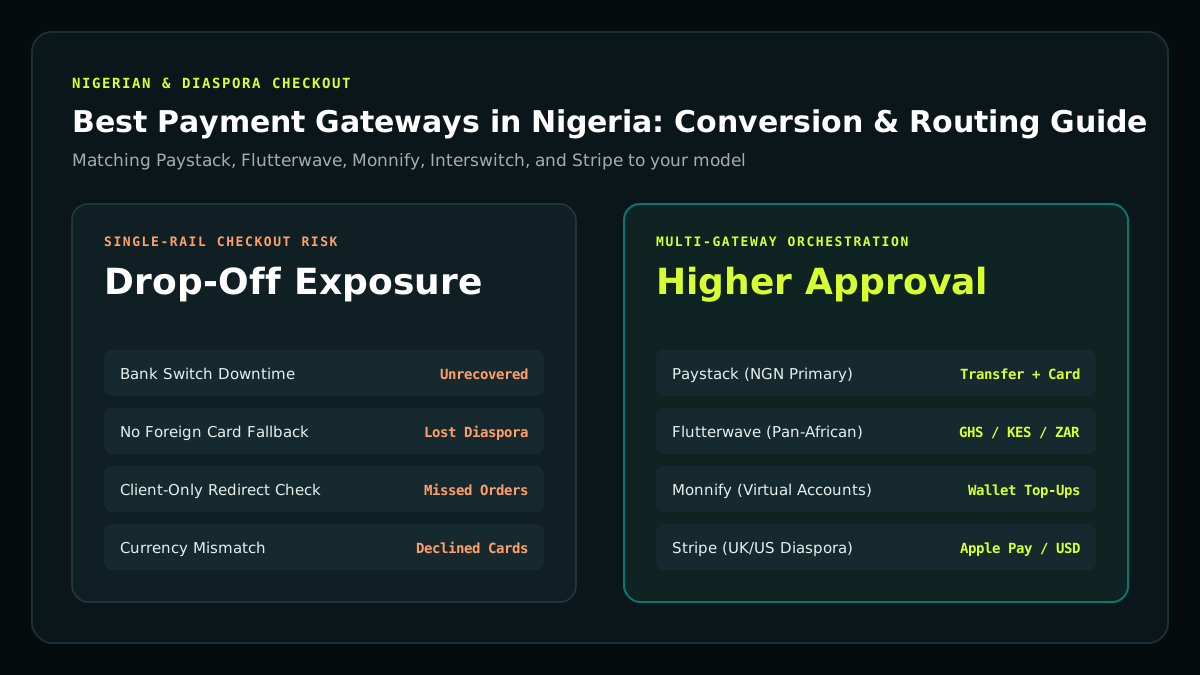
- Intermittent Bank Switch Congestion: During salary week, Black Friday drops, or holiday weekends, individual NIP bank switches occasionally lag. Offering instant fallback between bank transfer, USSD, and card—or routing across two gateways—recovers revenue that single-rail stores lose silently.
- Asynchronous Server-Side Webhooks: Never mark an order paid solely because the customer's browser redirected back to
/thank-you. Shoppers close tabs early or lose 4G signal mid-transfer; your server must verify cryptographic HMAC signatures on provider webhooks and run status-requery jobs.
Top Payment Gateways Compared (2026)
| Gateway | Strongest Use Case | Local Channels Supported | Multi-Currency / Global Reach | Engineering & UX Verdict |
| :--- | :--- | :--- | :--- | :--- |
| Paystack | Nigerian D2C ecommerce, SaaS & recurring billing | Cards, Pay With Transfer, USSD, Bank, Apple Pay (eligible) | NGN, GHS, ZAR, KES, USD (select merchants) | Best-in-class API docs, crisp modal UX, reliable T+1 settlement |
| Flutterwave | Pan-African commerce & cross-border apps | Cards, Bank Transfer, USSD, Mobile Money | Broad African currencies + USD, GBP, EUR | Strongest multi-country African payment coverage |
| Monnify (by Moniepoint) | Fintech wallets & high-volume virtual accounts | Reserved & dynamic virtual accounts, transfers, cards | NGN focused | Exceptional for instant transfer reconciliation & marketplace wallets |
| Interswitch WebPAY | Institutional, billers & enterprise portals | Verve, Mastercard, Visa, Quickteller | NGN / Enterprise rails | Deep bank-level institutional trust & high-value corporate acceptance |
| Stripe (via UK/US entity) | Diaspora & global D2C / SaaS brands | Global Visa/Mastercard/Amex, Apple Pay, Google Pay, SEPA | 135+ currencies | Unmatched international conversion when paired with a US LLC or UK Ltd |
Paystack vs. Flutterwave vs. Monnify: Engineering Notes
Choosing the right primary processor depends on what you are building:
- For Nigerian D2C Retail & Boutiques: Paystack is usually the cleanest default. Its Checkout modal loads rapidly on mobile data, supports instant Pay With Transfer polling, and provides straightforward split-payment and subscription endpoints. Typical local fees sit around 1.5% + ₦100 (capped at ₦2,000 on local Naira transactions), though merchants should always confirm exact current fee schedules on Paystack's pricing page.
- For Multi-Country African Startups: If customers pay you from Accra, Nairobi, Kigali, and Johannesburg in local Mobile Money or local currencies alongside Lagos, Flutterwave unifies those diverse African rails behind one integration.
- For Wallet-Based Apps, Cooperatives & Marketplaces: Monnify and Paystack Dedicated Virtual Accounts let you assign permanent bank account numbers to individual users or vendors so incoming bank transfers credit app balances automatically within seconds.
- For Enterprise Billers & Schools: Interswitch remains deeply entrenched in institutional Nigerian banking infrastructure and large-volume tuition or utility collection portals.
Selling to Diaspora Customers in USD, GBP & EUR
One of the biggest conversion leaks for Nigerian fashion labels, food exporters, and software firms is showing Naira prices only to customers browsing from London, Toronto, or Houston. Foreign Visa and Mastercard issuers routinely decline unexpected Naira acquirer charges due to cross-border fraud filters.
Conversely, showing USD totals to a shopper in Ikeja adds confusing FX anxiety. The cleanest architecture detects shopper region/currency preference and pairs Paystack or Monnify for NGN domestic settlement with Stripe for international USD/GBP/EUR checkout (for brands operating a UK Ltd or US LLC alongside Nigerian operations). You also comply cleanly with domestic settlement rules overseen by the Central Bank of Nigeria (CBN) and keep international revenue flowing smoothly.
Webhook Security, Idempotency & Reconciliation Best Practices
Regardless of which gateway you integrate, enforce these five engineering safeguards before going live:
- Verify HMAC Signatures on Every Webhook: Reject any callback missing a valid cryptographic signature header (
x-paystack-signature,verif-hash, orstripe-signature) so attackers cannot spoof fake paid notifications.
- Use Unique Transaction References & Idempotency: Never credit an order or wallet twice if a gateway delivers the same webhook event three times during network retries.
- Match Exact Amount & Currency Server-Side: Confirm that
paid_amount >= expected_order_totalandcurrency === expected_currencybefore marking an order fulfilled.
- Add a Manual 'Verify Payment' Button for Pending Transfers: If a customer transferred via bank app and closed the modal early, a one-click server requery endpoint lets them confirm settlement immediately without messaging support.
- Log Every Settlement Exception: Build an operations view showing failed webhooks, partial transfers, and disputed chargebacks in one place.
How ByteBelle Engineers Multi-Gateway Checkout
Unlike template builders that lock you into one rigid plugin or charge extra platform penalties when you connect Paystack, Byte Launchpad and ByteBelle Commerce wire your preferred gateways directly into your storefront with zero platform surcharge.
Explore how our payment orchestration supports regulated products on Secure Fintech App Engineering, compare full store budgets in our Ecommerce Website Cost in Nigeria Guide, or configure multi-gateway checkout on Build Your Project.
Handling Failed Bank Transfers, Chargebacks & Disputes Smoothly
Even with the best payment gateways in Nigeria, bank network lags happen. How your checkout handles an interrupted transfer determines whether a customer completes the purchase or disputes the charge with their bank:
- Clear Pending States Over Generic Error Screens: When a customer transfers funds from a bank app and the NIP credit takes 60 seconds to clear, display an automatic polling screen ('Confirming your transfer...') paired with an instant email/WhatsApp receipt once the webhook settles—preventing anxious double transfers.
- Automated Requery Cron Jobs: Never rely on a single incoming webhook attempt. Schedule a background job every 5 minutes to query pending checkout references from the past 2 hours directly against Paystack, Flutterwave, or Monnify APIs so delayed transfers still mark orders paid.
- Evidence Logs for Card Chargebacks: Store IP address, timestamp, delivery confirmation photo, and gateway transaction reference on every fulfilled order so finance teams win illegitimate card chargeback claims quickly.
- Partial Refunds & Store Wallet Credits: For fashion or retail brands handling size exchanges, issuing instant store wallet credit avoids slow inter-bank refund settlement delays while keeping revenue inside your brand.
Checklist: What Your Finance & Dev Teams Must Verify Before Going Live
- Switch Test Keys (
pk_test/sk_test) to Live Production Keys (pk_live/sk_live) in encrypted server environment variables only—never commit secret keys into frontend JavaScript.
- Confirm Live Webhook URLs point to your production HTTPS endpoint with valid SSL certificates.
- Test Subaccount & Split Payout Percentages if running a multi-vendor marketplace so commissions and vendor payouts reconcile to the exact kobo.
- Verify Settlement Bank Accounts & BVN/CAC KYC Approval inside each gateway dashboard days before launching paid ads so payouts are never held pending compliance review.
- Audit Checkout Copy & Fee Transparency: Clearly display NGN/USD totals, shipping fees, and VAT before customers open the payment modal so unexpected last-second charges never cause cart abandonment.
Subscription & Recurring Billing Considerations in Nigeria
If you run a SaaS product, membership community, coaching programme, or B2B retainer service, recurring billing introduces extra edge cases beyond one-time ecommerce checkouts. Card tokenization rules in Nigeria differ across Visa, Mastercard, and Verve cards—some issuing banks require 3D Secure OTP prompts on recurring charges unless recurring authorisation tokens are configured properly with your processor. Building automatic dunning retries, WhatsApp/email renewal reminders 48 hours ahead of billing, and instant self-service transfer fallback links prevents involuntary churn from silently eroding your monthly recurring revenue.
Equally important, test settlement currency matching carefully: avoid charging Naira cards for USD-denominated subscriptions at volatile bank rates when offering transparent NGN annual or quarterly plans via Paystack converts substantially better for domestic Nigerian teams.
Cross-Border Treasury & Settlement Timing for Nigerian Merchandising
Beyond gateway checkout conversion, treasury timing directly affects how quickly your business restocks inventory. Domestic Naira card and bank-transfer settlements on Paystack, Flutterwave, and Monnify typically clear on a T+1 business-day cycle—meaning Friday evening orders settle on Monday or Tuesday depending on public holidays. When selling internationally via Stripe into a US or UK business bank account, initial payouts often settle on a 2-to-7-day rolling schedule before tightening to T+2 as account history matures.
Smart commerce teams design their operations dashboards around settlement batch IDs rather than raw checkout timestamps. Tagging every fulfilled order with its gateway fee, net settlement amount, and bank payout batch reference makes end-of-month accounting and VAT reconciliation effortless for your finance controller.
Best payment gateways in Nigeria: acceptance checks
Evaluate the best payment gateways in Nigeria using your payment methods, refund process and reconciliation needs. Ask your finance team which transaction references and settlement exports they need before choosing an integration.
Executive FAQ: Common Questions Answered
Which is better for a Nigerian online store: Paystack or Flutterwave?+
For businesses selling primarily inside Nigeria, Paystack generally offers the cleanest checkout modal, reliable transfer confirmation, and straightforward API tooling. If you accept payments from customers across multiple African countries (Ghana, Kenya, South Africa) in local currencies, Flutterwave's Pan-African coverage is a strong advantage.
Can I use two payment gateways on the same website or app?+
Yes. High-volume stores and fintech platforms often configure a primary domestic gateway (such as Paystack or Monnify) alongside a secondary fallback or international gateway (such as Stripe for USD/GBP orders). ByteBelle supports multi-gateway routing as a standard commercial add-on.
Can Nigerian businesses use Stripe directly?+
Stripe does not natively onboard Nigerian-domiciled entities directly without a supported foreign entity (such as a US LLC or UK Ltd with matching banking). Many global-facing Nigerian brands incorporate a US/UK entity for Stripe while keeping Paystack for domestic Naira settlements.